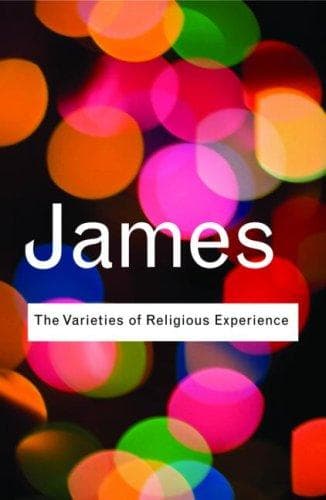
The Varieties of Religious Experience: A Study in Human NatureJames, William
ReligionComparative
The Varieties of Religious Experience: A Study in Human Nature
James, William
Conversion; Experience (Religion); Philosophy and religion; Psychology, Religious; Religion
Perfect conduct is a relation between three terms: the actor, the objects
for which he acts, and the recipients of the action. In order that conduct
should be abstractly perfect, all three terms, intention, execution, and
reception, should be suited to one another. The best intention will fail
if it either work by false means or address itself to the wrong recipient.
Thus no critic or estimator of the value of conduct can confine himself to
the actor’s animus alone, apart from the other elements of the
performance. As there is no worse lie than a truth misunderstood by those
who hear it, so reasonable arguments, challenges to magnanimity, and
appeals to sympathy or justice, are folly when we are dealing with human
crocodiles and boa‐constrictors. The saint may simply give the universe
into the hands of the enemy by his trustfulness. He may by non‐resistance
cut off his own survival.
Herbert Spencer tells us that the perfect man’s conduct will appear
perfect only when the environment is perfect: to no inferior environment
is it suitably adapted. We may paraphrase this by cordially admitting that
saintly conduct would be the most perfect conduct conceivable in an
environment where all were saints already; but by adding that in an
environment where few are saints, and many the exact reverse of saints, it
must be ill adapted. We must frankly confess, then, using our empirical
common sense and ordinary practical prejudices, that in the world that
actually is, the virtues of sympathy, charity, and non‐resistance may be,
and often have been, manifested in excess. The powers of darkness have
systematically taken advantage of them. The whole modern scientific
organization of charity is a consequence of the failure of simply giving
alms. The whole history of constitutional government is a commentary on
the excellence of resisting evil, and when one cheek is smitten, of
smiting back and not turning the other cheek also.
You will agree to this in general, for in spite of the Gospel, in spite of
Quakerism, in spite of Tolstoi, you believe in fighting fire with fire, in
shooting down usurpers, locking up thieves, and freezing out vagabonds and
swindlers.
And yet you are sure, as I am sure, that were the world confined to these
hard‐headed, hard‐hearted, and hard‐fisted methods exclusively, were there
no one prompt to help a brother first, and find out afterwards whether he
were worthy; no one willing to drown his private wrongs in pity for the
wronger’s person; no one ready to be duped many a time rather than live
always on suspicion; no one glad to treat individuals passionately and
impulsively rather than by general rules of prudence; the world would be
an infinitely worse place than it is now to live in. The tender grace, not
of a day that is dead, but of a day yet to be born somehow, with the
golden rule grown natural, would be cut out from the perspective of our
imaginations.
Public-domain text, read in full here on John Shaqi.
Reviews
Reviews
No reviews yet
Be the first to share your thoughts on this work.
Elsewhere in the archive
Join the Discussion
Join the discussion
Sign in to leave a comment or review.
Sign InorCreate an account