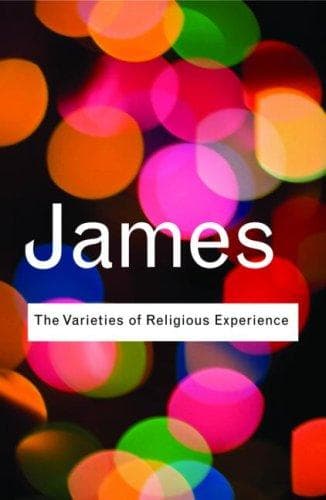
The Varieties of Religious Experience: A Study in Human NatureJames, William
ReligionComparative
The Varieties of Religious Experience: A Study in Human Nature
James, William
Conversion; Experience (Religion); Philosophy and religion; Psychology, Religious; Religion
and curious entertainment to listen to than mine. Yet I doubt whether he
will necessarily, by his control of so much more out‐of‐the‐way material,
get much closer to the essence of the matter in hand.
The question, What are the religious propensities? and the question, What
is their philosophic significance? are two entirely different orders of
question from the logical point of view; and, as a failure to recognize
this fact distinctly may breed confusion, I wish to insist upon the point
a little before we enter into the documents and materials to which I have
referred.
In recent books on logic, distinction is made between two orders of
inquiry concerning anything. First, what is the nature of it? how did it
come about? what is its constitution, origin, and history? And second,
What is its importance, meaning, or significance, now that it is once
here? The answer to the one question is given in an _existential judgment_
or proposition. The answer to the other is a _proposition of value_, what
the Germans call a _Werthurtheil_, or what we may, if we like, denominate
a _spiritual judgment_. Neither judgment can be deduced immediately from
the other. They proceed from diverse intellectual preoccupations, and the
mind combines them only by making them first separately, and then adding
them together.
In the matter of religions it is particularly easy to distinguish the two
orders of question. Every religious phenomenon has its history and its
derivation from natural antecedents. What is nowadays called the higher
criticism of the Bible is only a study of the Bible from this existential
point of view, neglected too much by the earlier church. Under just what
biographic conditions did the sacred writers bring forth their various
contributions to the holy volume? And what had they exactly in their
several individual minds, when they delivered their utterances? These are
manifestly questions of historical fact, and one does not see how the
answer to them can decide offhand the still further question: of what use
should such a volume, with its manner of coming into existence so defined,
be to us as a guide to life and a revelation? To answer this other
question we must have already in our mind some sort of a general theory as
to what the peculiarities in a thing should be which give it value for
purposes of revelation; and this theory itself would be what I just called
a spiritual judgment. Combining it with our existential judgment, we might
indeed deduce another spiritual judgment as to the Bible’s worth. Thus if
our theory of revelation‐value were to affirm that any book, to possess
it, must have been composed automatically or not by the free caprice of
the writer, or that it must exhibit no scientific and historic errors and
express no local or personal passions, the Bible would probably fare ill
at our hands. But if, on the other hand, our theory should allow that a
book may well be a revelation in spite of errors and passions and
Public-domain text, read in full here on John Shaqi.
Reviews
Reviews
No reviews yet
Be the first to share your thoughts on this work.
Join the Discussion
Join the discussion
Sign in to leave a comment or review.
Sign InorCreate an account