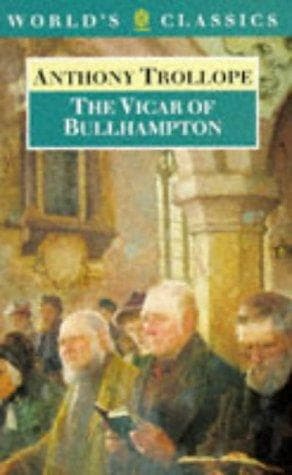
THE VICAR OF BULLHAMPTON.
by
ANTHONY TROLLOPE.
With Thirty Illustrations by H. Woods.
[Illustration: Waiting-Room at the Assize Court. (frontispiece)]
[Illustration for title page]
London:
Bradbury, Evans, and Co., 11, Bouverie Street.
1870.
PREFACE.
The writing of prefaces is, for the most part, work thrown away; and
the writing of a preface to a novel is almost always a vain thing.
Nevertheless, I am tempted to prefix a few words to this novel on
its completion, not expecting that many people will read them, but
desirous, in doing so, of defending myself against a charge which may
possibly be made against me by the critics,--as to which I shall be
unwilling to revert after it shall have been preferred.
I have introduced in the Vicar of Bullhampton the character of a girl
whom I will call,--for want of a truer word that shall not in its
truth be offensive,--a castaway. I have endeavoured to endow her with
qualities that may create sympathy, and I have brought her back at
last from degradation at least to decency. I have not married her to
a wealthy lover, and I have endeavoured to explain that though there
was possible to her a way out of perdition, still things could not be
with her as they would have been had she not fallen.
There arises, of course, the question whether a novelist, who
professes to write for the amusement of the young of both sexes,
should allow himself to bring upon his stage such a character as that
of Carry Brattle? It is not long since,--it is well within the memory
of the author,--that the very existence of such a condition of life,
as was hers, was supposed to be unknown to our sisters and daughters,
and was, in truth, unknown to many of them. Whether that ignorance
was good may be questioned; but that it exists no longer is beyond
question. Then arises that further question,--how far the condition
of such unfortunates should be made a matter of concern to the sweet
young hearts of those whose delicacy and cleanliness of thought is a
matter of pride to so many of us. Cannot women, who are good, pity
the sufferings of the vicious, and do something perhaps to mitigate
and shorten them, without contamination from the vice? It will be
admitted probably by most men who have thought upon the subject that
no fault among us is punished so heavily as that fault, often so
light in itself but so terrible in its consequences to the less
faulty of the two offenders, by which a woman falls. All her own sex
is against her,--and all those of the other sex in whose veins runs
the blood which she is thought to have contaminated, and who, of
nature, would befriend her were her trouble any other than it is.
Public-domain text, read in full here on John Shaqi.
Reviews
Reviews
No reviews yet
Be the first to share your thoughts on this work.
Join the Discussion
Join the discussion
Sign in to leave a comment or review.
Sign InorCreate an account