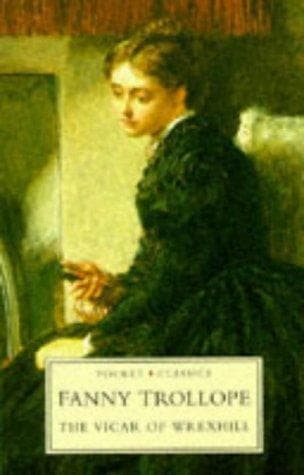
Clergy -- Fiction; Great Britain -- Fiction; Religious fiction
The first person who entered the drawing-room was Mrs. Simpson. On all
occasions, indeed, this lady exerted herself to sustain the position of
"the principal person in the village." She seldom gave an order for "the
fly," which, weak as were its own springs, was, in truth, the
main-spring of all the rural visitings; she seldom ordered this
indispensable commodity without adding to her instructions, "Pray be
punctual, Mr. Sims,--I say this for your sake as well as my own; for if
the principal person in the village is made to wait, you may depend upon
it an opposition will be started immediately, and in that case, you
know, I should be obliged to give it my patronage." In like manner, the
butcher and baker in the village, the ruddy-faced milkman out of it, the
shoemaker, the dressmaker, the carpenter, the glazier, the dealer in
small wares and all wares, were severally and collectively given to
understand that Mrs. Simpson, as the principal person in the village,
had a right to expect the first-fruits of their civility, attention,
industry, and general stock-in-trade.
Her entrance into the presence of Mrs. Mowbray was as pregnant with
sentiment and sympathy as the degree of intimacy to which she was
admitted would permit. The hand-shaking was performed with a little
pressure and a little sigh; every pause in the conversation was made to
speak volumes by the sad tone in which the next sentence was spoken: in
short, if the minds of Mrs. Mowbray, her eldest daughter, and her ward,
who kindly volunteered to sustain this ordeal with her, had not been
fully occupied by the recent event, almost every word, look, and gesture
of the principal person of Wrexhill were calculated to recall it.
Mrs. Simpson was accompanied by her pretty little girl, flowered and
furbelowed into as near a resemblance to a bantam chicken as it was
possible for a pretty little girl to take.
The distance from the village to the Park was almost too great for so
young a child to walk, and the poor little thing looked heated, cross,
and weary; but her mamma declared that a ramble through those delicious
fields was the greatest treat in the world. "I trust in Heaven," she
continued, using her near-sighted eye-glass to look at a drawing which
lay on the table, "that Mimima" (her abbreviation of Jemima) "will have
my taste for sketching--I like to take her out with me, dear pet, she
enjoys it so! but at this lovely season it is the most difficult thing
in the world not to sketch as one goes. Indeed, when the mind is
pre-occupied"--(a sigh)--"every object, however"--(a pause)--"I beg your
pardon, but it is so difficult--"
"Come to me, Jemima," said Helen, holding out her hand, "and let me take
your bonnet off."
The child put up her shoulder, and pressed with distressing closeness
upon the delicate lilac of her mother's new silk dress.
"It is such a shy puss!" said Mrs. Simpson; "I often think what would
become of her"--(a sigh). "I beg your pardon--but sad thoughts will
press--"
Public-domain text, read in full here on John Shaqi.
Reviews
Reviews
No reviews yet
Be the first to share your thoughts on this work.
Join the Discussion
Join the discussion
Sign in to leave a comment or review.
Sign InorCreate an account