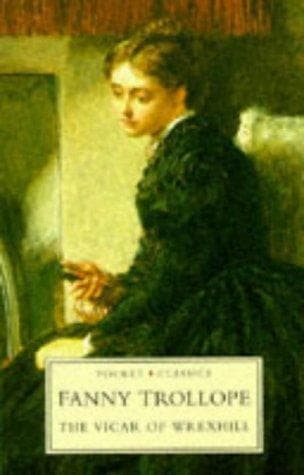
Clergy -- Fiction; Great Britain -- Fiction; Religious fiction
No sudden and unexpected burst of sunshine ever produced a greater
change in the aspect of a watery landscape, than the entrance of this
party on the countenance of the handsome widow. Had Rosalind been
present, she would have found some amusement, or at least some
occupation, in seeking to discover whether it were the father or son who
possessed this vivifying power. To the pale, hollow-eyed daughter she
would certainly have attributed no such influence. But as we have not
her help to decide the doubt, we must leave the matter to the slower
hand of time.
Mr. Jacob Cartwright was a tall, straight, young man, but as yet a
little inclining to that line of contour, which can only be described by
the expressive word lanky. Neither was his hair handsome, for,
designated as "light" by his particular friends and admirers, it was
called "sandy" by the rest of the world. But the young gentleman had a
finely-formed mouth, with a very beautiful set of teeth, and a large
clear light blue eye, which many persons declared to be beautiful.
This young man was said to resemble greatly the mother he had lost: to
his father he was certainly as unlike as possible. Mr. Cartwright,
though somewhat above the middle height, was shorter than his son, and
his person incomparably better built; his features were very regularly
handsome, and the habitual expression of his countenance gentle and
attractive. His eyes were large, dark, and very beautifully formed, and
his hair and beard as black as those of a Spaniard, save here and there
a silver line which about the temples began to mix itself with the
sable. His mouth and teeth perhaps might have been said to resemble
those of his son, had not the expression been so different. In the son
these constituted merely a well-formed feature; to the father they
seemed to give a power when he spoke that might work wonders either for
good or evil.
Henrietta Cartwright resembled neither of them: of the two, she would
have been said to be most like her father, because her hair and eyes
were dark; but the form of the head and face, and above all, the cynic
expression of the mouth, were in perfect contrast to his. Like her
brother she was extremely thin; but she was not proportionably tall, and
in her this ascetic form seemed rather the result of ill health than of
make. She was moreover deadly pale, and seldom spoke in general society
if she could possibly avoid it.
Mrs. Mowbray received all the party with cordial kindness. In Helen's
manner there was a shade of coldness, especially to the father, whose
offered hand she did not appear to see; but the whole trio shared the
affectionate greetings of Mrs. Simpson.
Public-domain text, read in full here on John Shaqi.
Reviews
Reviews
No reviews yet
Be the first to share your thoughts on this work.
Join the Discussion
Join the discussion
Sign in to leave a comment or review.
Sign InorCreate an account