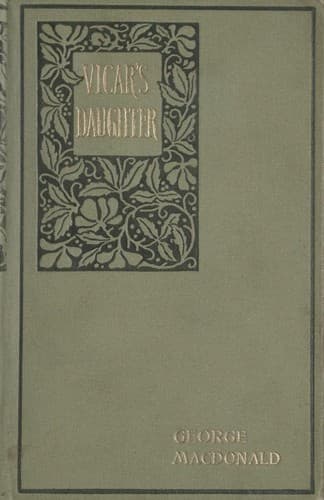
Children of clergy -- Fiction; Christian fiction; Fathers and daughters -- Fiction; Scotland -- Fiction
She stopped: she was on the point of going too far, she thought.
"So long as what?" he returned sternly.
"So long as you are a worshipper of Mammon," she answered; and left the
room.
She burst out crying when she came to this point. She had narrated the
whole with the air of one making a confession.
"I am afraid it was very wrong," she said; "and if so, then it was very
rude as well. But something seemed to force it out of me. Just think: there
was a generous heart, clogged up with self-importance and wealth! To me, as
he stood there on the hearth-rug, he was a most pitiable object--with an
impervious wall betwixt him and the kingdom of heaven! He seemed like a man
in a terrible dream, from which I _must_ awake him by calling aloud in his
ear--except that, alas! the dream was not terrible to him, only to me! If
he had been one of my poor friends, guilty of some plain fault, I should
have told him so without compunction; and why not, being what he was? There
he stood,--a man of estimable qualities, of beneficence, if not bounty;
no miser, nor consciously unjust; yet a man whose heart the moth and rust
were eating into a sponge!--who went to church every Sunday, and had many
friends, not one of whom, not even his own wife, would tell him that he was
a Mammon-worshipper, and losing his life. It may have been useless, it may
have been wrong; but I felt driven to it by bare human pity for the misery
I saw before me."
"It looks to me as if you had the message given you to give him," I said.
"But--though I don't know it--what if I was annoyed with him for offering
me that wretched hundred pounds,--in doing which he was acting up to the
light that was in him?"
I could not help thinking of the light which is darkness, but I did not
say so. Strange tableau, in this our would-be grand nineteenth century,--a
young and poor woman prophet-like rebuking a wealthy London merchant on
his own hearth-rug, as a worshipper of Mammon! I think she was right; not
because he was wrong, but because, as I firmly believe, she did it from no
personal motives whatever, although in her modesty she doubted herself. I
believe it was from pure regard for the man and for the truth, urging her
to an irrepressible utterance. If so, should we not say that she spoke by
the Spirit? Only I shudder to think what utterance might, with an equal
outward show, be attributed to the same Spirit. Well, to his own master
every one standeth or falleth; whether an old prophet who, with a lie in
his right hand, entraps an honorable guest, or a young prophet who, with
repentance in his heart, walks calmly into the jaws of the waiting lion.
[Footnote: See the Sermons of the Rev. Henry Whitehead, vicar of St.
John's, Limehouse; as remarkable for the profundity of their insight us
for the noble severity of their literary modelling.--G.M.D.]
Public-domain text, read in full here on John Shaqi.
Reviews
Reviews
No reviews yet
Be the first to share your thoughts on this work.
Elsewhere in the archive
Join the Discussion
Join the discussion
Sign in to leave a comment or review.
Sign InorCreate an account