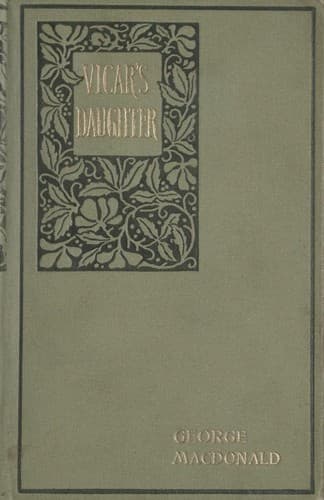
Children of clergy -- Fiction; Christian fiction; Fathers and daughters -- Fiction; Scotland -- Fiction
"Why didn't ye stop at home then? I didn't tell ye to go," he said
fiercely, calling her a coarse name.
"Richard," said Marion, "such words are not fit for _me_ to hear, still
less for your own wife."
"Oh! never mind me: I'm used to sich," said the woman spitefully.
"It's a lie," roared the man: "I never named sich a word to ye afore. It do
make me mad to hear ye. I drink the clothes off your back, do I? If I bed
the money, ye might go in velvet and lace for aught I cared!"
"_She_ would care little to go in gold and diamonds, if _you_ didn't care
to see her in them," said Marion.
At this the woman burst into fresh tears, and the man put on a face of
contempt,--the worst sign, Marion said, she had yet seen in him, not
excepting the blow; for to despise is worse than to strike.
I can't help stopping my story here to put in a reflection that forces
itself upon me. Many a man would regard with disgust the idea of striking
his wife, who will yet cherish against her an aversion which is infinitely
worse. The working-man who strikes his wife, but is sorry for it, and tries
to make amends by being more tender after it, a result which many a woman
will consider cheap at the price of a blow endured,--is an immeasurably
superior husband to the gentleman who shows his wife the most absolute
politeness, but uses that very politeness as a breastwork to fortify
himself in his disregard and contempt.
Marion saw that while the tides ran thus high, nothing could be done;
certainly, at least, in the way of argument. Whether the man had been
drinking she could not tell, but suspected that must have a share in the
evil of his mood. She went up to him, laid her hand on his shoulder, and
said,--
"You're out of sorts, Richard. Come and have a cup of tea, and I will sing
to you."
"I don't want no tea."
"You're fond of the piano, though. And you like to hear me sing, don't
you?"
"Well, I do," he muttered, as if the admission were forced from him.
"Come with me, then."
He dragged himself up from his chair, and was about to follow her.
"You ain't going to take him from me, grannie, after he's been and struck
me?" interposed his wife, in a tone half pathetic, half injured.
"Come after us in a few minutes," said Marion, in a low voice, and led the
way from the room.
Quiet as a lamb Richard followed her up stairs. She made him sit in the
easy-chair, and began with a low, plaintive song, which she followed with
other songs and music of a similar character. He neither heard nor saw his
wife enter, and both sat for about twenty minutes without a word spoken.
Then Marion made a pause, and the wife rose and approached her husband. He
was fast asleep.
"Don't wake him," said Marion; "let him have his sleep out. You go down and
get the place tidy, and a nice bit of supper for him--if you can."
"Oh, yes! he brought me home his week's wages this very night."
"The whole?"
"Yes, grannie"
Public-domain text, read in full here on John Shaqi.
Reviews
Reviews
No reviews yet
Be the first to share your thoughts on this work.
Elsewhere in the archive
Join the Discussion
Join the discussion
Sign in to leave a comment or review.
Sign InorCreate an account