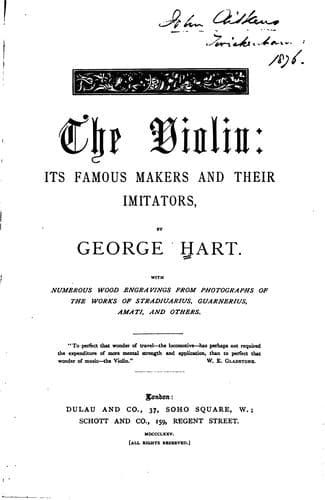
The Violin: Its Famous Makers and Their ImitatorsHart, George
History
The Violin: Its Famous Makers and Their Imitators
Hart, George
Violin -- History; Violin makers -- Biography
[Footnote 22: The Marquis of Ariberti was born in 1666, and died 1724.
He was an elegant writer, and a member of several literary academies.
He was for some time in Tuscany. Upon returning to Cremona, where he
settled, he built in 1687, at his own expense, a theatre called after
his own name, Ariberti. He, being a passionate lover of music, was
anxious to have in his own establishment (the theatre adjoining his
palace) a place of amusement for himself and his family. About the
year 1710 he gave up the building to a religious brotherhood, and a
church was built on the site, and used until 1798, when the
brotherhood was suppressed, and, by a singular coincidence, the
building was bought in 1801 by a society of dramatic authors, and
again opened as a theatre, which still exists, and is called Teatro
Filodrammatico. The Marquis Ariberti was appointed by Joseph I.,
Emperor of Austria, to the title of Lieutenant-Marshal; he was a
member of the High Council of State in Milan. He was buried in the
church, which, as above mentioned, was afterwards used as a theatre.
(_See_ Lancetti, "Biografia Cremonese," I vol., Milano, 1819.)]
[Footnote 23: Cosimo III. de Medici.]
[Footnote 24: A chest of Viols, Mace tells us, in his "Musick's
Monument," 1676, consisted of two Basses, two Tenors, and two Trebles.
A Concerto of Violins in Italy, according to the letter of Ariberti,
consisted of one Bass, two Tenors (Contralto and Tenor) and two
Violins. The term "Concerto" was introduced at the beginning of the
17th century, in connection with sacred music in parts. These
compositions were called Church Concertos. Towards the end of the 17th
century compositions were introduced for instruments called Chamber
Concertos.]
Public-domain text, read in full here on John Shaqi.
Reviews
Reviews
No reviews yet
Be the first to share your thoughts on this work.
Elsewhere in the archive
Join the Discussion
Join the discussion
Sign in to leave a comment or review.
Sign InorCreate an account