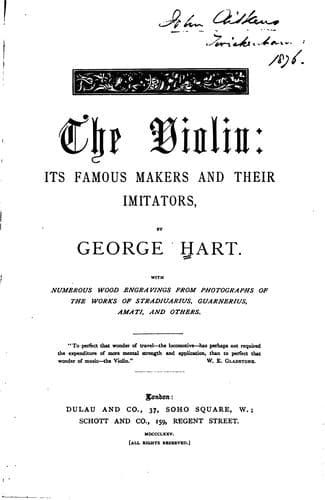
The Violin: Its Famous Makers and Their ImitatorsHart, George
History
The Violin: Its Famous Makers and Their Imitators
Hart, George
Violin -- History; Violin makers -- Biography
In the collection of relics of the great master, in the possession of
the Marquis Dalla Valle, there are some items which appear to be
connected with this most interesting letter: I refer to the designs
for a case, or cases, for a concerto of instruments dated 1684, which
Stradivari himself describes as being for the Grand Duke of Florence.
The date upon these designs is indicative of the order for the Violins
and the Violoncellos having been given in that year (1684) by the
Marquis Ariberti, who at the same time gave certain instructions as to
cases and armorial designs. The completion of the order, however,
appears to have been delayed, and the instruments were not delivered
until 1690. The instructions given in the above letter to Stradivari
to complete the concerto by making the Tenors (the patterns of which
are among those in the possession of the Marquis Dalla Valle, signed,
and dated 1690), and the existence of the Violoncello and one of the
Tenors at Florence, dated 1690, are confirmatory of the opinion that
the order was executed in 1690. The following inscription, under the
left shoulder or side, is in the Tenor: "Prima 20 Ottobre 1690 per S.
A. Da Fiorenza." It is interesting to find that the Grand Duke also
possessed a Stradivari Violin, dated 1716, which is in Florence,
together with the instruments above referred to. It is therefore
evident that the belief of the Marquis that Stradivari would receive
further orders from the Grand Duke was realised.
Between the years 1690 and 1700 Stradivari made, together with the
form of instrument just described, that known to connoisseurs as the
"long Strad." We have here quite a differently constructed instrument;
it is less graceful, although there is no absence of the masterly hand
throughout the work. It has received the title of "long Strad" from
its increased length, as the name would imply.[25]
[Footnote 25: The usual length measurements of the various patterns
are as under:--
(1) "Amatise," 13-7/8 inches.
(2) "Long Strad," 14-1/8 (occasionally 14-1/4) inches.
(3) "Grand pattern," 14 to 14-1/16 inches.--EDITORS.]
Fortified with the experience which the variously constructed
instruments referred to had enabled him to gather, he would seem to
have marshalled all his forces in order to enter on an entirely new
campaign, one that should be alike glorious to himself and his art.
That he succeeded in achieving all that he could have desired, my
readers will have an opportunity of judging by the evidence I propose
to offer. It was about the year 1700 when Stradivari entered upon a
new era in his art. All his past labours appear to have been only
measures preliminary to that which he proposed afterwards to
accomplish, and were made for the purpose of testing, to the minutest
degree, the effect of particular modifications in the form and
thickness of his works.
Public-domain text, read in full here on John Shaqi.
Reviews
Reviews
No reviews yet
Be the first to share your thoughts on this work.
Elsewhere in the archive
Join the Discussion
Join the discussion
Sign in to leave a comment or review.
Sign InorCreate an account