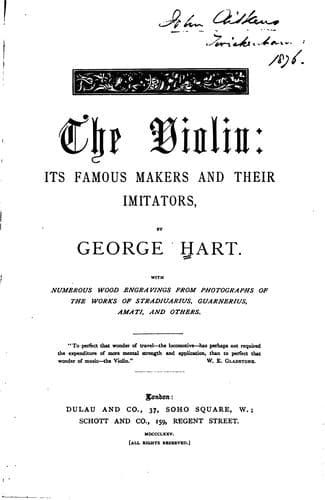
The Violin: Its Famous Makers and Their ImitatorsHart, George
History
The Violin: Its Famous Makers and Their Imitators
Hart, George
Violin -- History; Violin makers -- Biography
It is not possible to convey to the reader, by means of mere
description, anything approaching an adequate notion of the surpassing
gracefulness of the entire work of this epoch. The eye must be made
the channel to the mind. If the work is present, then, with the aid
which these remarks will afford, the reader may gain, by careful
study, much valuable insight into the beauties and genius of this
famous artist, together with much useful information.
But during this period of his maturity, even, we find that Stradivari
did not absolutely confine himself to making instruments as near as
possible alike; on the contrary, it is easy to point out certain
variations, the meaning of which he doubtless well understood. We find
him guided throughout this period by his usual ideas as regards
grandeur of outline and degrees of thickness; but the rotundity of the
model, the shape that he gave to the sound-hole, the method of setting
the sound-hole in the instrument, although, as before remarked, all
executed with a breadth of purpose which his earlier efforts fail to
show, may be cited as points in which he varied. I have no hesitation
in hazarding an explanation of the reasons that prompted him to these
differences of construction. It is my firm conviction that these great
makers had certain guiding principles as regards the nature and
qualities of the wood they used, and that Stradivari, in particular,
made the subject a special study. If this be granted, I do not think
there is any great difficulty in understanding the meaning of the
differences pointed out. If Stradivari constructed his instruments
upon philosophical principles, the chief element of variation in the
treatment of any particular instrument must have been the difference
of _quality_ in the material; it is evident that a method eminently
successful when applied to wood of a certain texture and character,
would ensure as eminent a failure if applied indiscriminately in all
cases. To obtain wood sufficient for two bellies that should be alike
in every particular is impossible, though cuttings should be made from
the same piece; and we find that the more the material varies in its
nature, so much the greater the variations--a fact which helps the
view advanced considerably. In another place I have stated that
scarcity of sycamore in the days of these old makers is impossible to
understand, but scarcity of a particular _kind_ of sycamore is easy to
comprehend. He might have had a cartload of wood handsome in
appearance; but handsome wood combined with acoustical properties he
deemed needful, was another matter. With what extraordinary care he
permitted himself to use the lovely wood he did possess! There are
several instances where he has used, during one year, four or five
distinct cuttings of wood, more particularly as regards the sycamore.
These several cuttings include often the handsomest and the plainest.
A year or so later we find him again making use of wood from the same
Public-domain text, read in full here on John Shaqi.
Reviews
Reviews
No reviews yet
Be the first to share your thoughts on this work.
Elsewhere in the archive
Join the Discussion
Join the discussion
Sign in to leave a comment or review.
Sign InorCreate an account