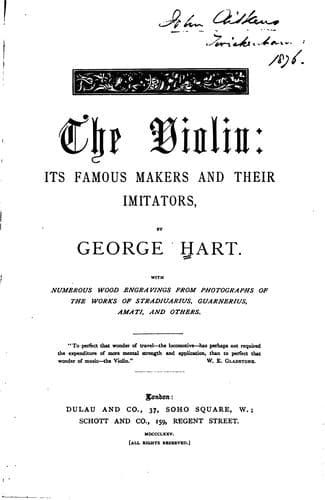
The Violin: Its Famous Makers and Their ImitatorsHart, George
History
The Violin: Its Famous Makers and Their Imitators
Hart, George
Violin -- History; Violin makers -- Biography
It is conceivable that a manufacture so successful as Violin-making
proves itself to have been in Italy during the seventeenth and part of
the eighteenth centuries, should give rise to scientific inquiry, in
order to discover the reason of the excellence of the best Italian
instruments, and, if possible, the principles or laws which guided the
makers in the exercise of their genius. That investigations of this
character should be attended with important results in connection with
the science of acoustics, is to be expected. As to laws or principles
of a scientific character, I doubt whether such were recognised or
understood when the excellence of the manufacture was greatest,
believing that Violin makers of the order of Stradivari must be like
poets, "born artificers, not made." The chief merits of Stradivari and
his contemporary makers were intuitive. Their rules, having their
origin in experience, were applied as dictated by their marvellous
sense of touch and cunning, with results infinitely superior to any
obtained with the aid of the most approved mechanical contrivances.
When to these considerations we add that devotedness of purpose,
without which nothing really great in art has been accomplished, we
have a catalogue of excellences sufficient to account for the
greatness of their achievements.
Turning again to the manuscript of Arisi, we find that "On the 12th of
May, 1701, Don Antonio Cavezudo, leader of the private orchestra of
King Charles II. of Spain, wrote a highly complimentary letter to
Stradivari from Madrid, assuring him that though he had received bow
instruments from several makers, for different courts, yet he had
never been able to obtain them of such a refined and beautiful tone as
those made by him." Arisi adds that Don Antonio Cavezudo was also in
the service of the Duke of Anjou.
M. Fetis, in his notice of Stradivari,[26] remarks: "The life of
Antonio Stradivari was as tranquil as his calling was peaceful. The
year 1702, alone, must have caused him much disquiet, when, during the
war concerning the succession, the city of Cremona was taken by
Marshal Villeroy, retaken by Prince Eugene, and finally taken a third
time by the French; but after that period Italy enjoyed a long
tranquillity, in which the old age of the artist glided peacefully
away."
[Footnote 26: "Notice of Anthony Stradivari," by F. J. Fetis,
translated by John Bishop. 1864.]
Public-domain text, read in full here on John Shaqi.
Reviews
Reviews
No reviews yet
Be the first to share your thoughts on this work.
Elsewhere in the archive
Join the Discussion
Join the discussion
Sign in to leave a comment or review.
Sign InorCreate an account