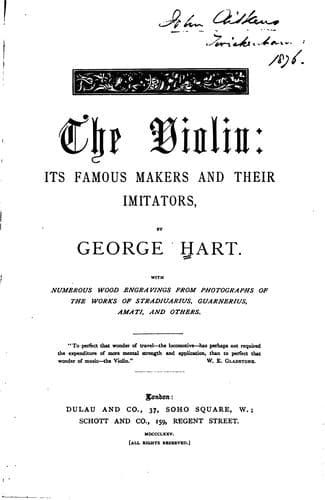
The Violin: Its Famous Makers and Their ImitatorsHart, George
History
The Violin: Its Famous Makers and Their Imitators
Hart, George
Violin -- History; Violin makers -- Biography
A campaign had taken place in Italy in 1701, when Prince Eugene, with
thirty thousand troops, out-generalled Catinat, the able French
commander, giving Louis XIV. the opportunity of placing the empty and
presumptuous Villeroy in command. Prince Eugene had greatly harassed
the French in Italy, when, in the night of February 1, 1702, he
surprised the French garrison of Cremona, and, though momentarily
successful, "missed the town," as Eugene said, "by a quarter of an
hour," but carried off the Commander-in-Chief, Villeroy, which the
popular song-writers of the day construed into "a double gain to
France"--Cremona saved, and Villeroy lost.
It is conceivable that Stradivari, together with his fellow-citizens,
witnessed during the year 1702 more of the pomp of war than was
agreeable. The blowing of trumpets, the beating of drums, and other
martial sounds, would be music not likely to touch pleasantly the ears
of Stradivari, apart from the discomfort attendant on military
occupation. He, however, appears to have practised his art with
undiminished zeal, judging from the following interesting information
given by Arisi. He says: "Stradivari made a complete set of bow
instruments, which he intended to present to Philip V. of Spain, on
the occasion of the passage of the King through Cremona; and he had
prepared a memorial to that effect; but he was dissuaded, and the
instruments are still in his possession."
No date is supplied with regard to the events above named; we are
therefore left to assign the period when the presentation was to have
taken place by reference to other sources of information. In an
official diary of the journey of Philip V. to Italy[27] it appears
that the King arrived in Lombardy on the 10th of June, 1702, and that
from Milan he went to Lodi on the 1st of July, and made his entry into
Cremona two days later, July the 3rd, at one o'clock in the afternoon.
Philip remained several days in the town, receiving visits from the
Dukes of Parma and of Mantua, and held there several councils of war
with the generals of the allied armies (Spanish and French), and
appears to have left Cremona on the 20th of July for the seat of war
near Mantua. After the victories of Luzzara and Guastalla, the King
passed again through Cremona, arriving there on the 3rd of October,
staying one night, and leaving the following day for Milan. On this
occasion there was much festivity on account of the victories, and the
King distributed sums of money and presents for the wounded, the
officers, and the generals. It would therefore appear that Stradivari
purposed presenting the instruments to Philip either in July or
October, 1702. The condition of affairs at Cremona at this period
apparently serves to explain the cause of Stradivari having been
dissuaded from presenting the instruments.
Public-domain text, read in full here on John Shaqi.
Reviews
Reviews
No reviews yet
Be the first to share your thoughts on this work.
Elsewhere in the archive
Join the Discussion
Join the discussion
Sign in to leave a comment or review.
Sign InorCreate an account