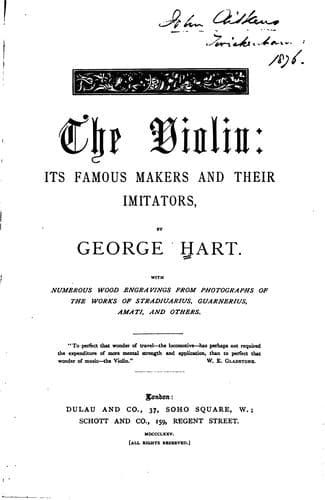
The Violin: Its Famous Makers and Their ImitatorsHart, George
History
The Violin: Its Famous Makers and Their Imitators
Hart, George
Violin -- History; Violin makers -- Biography
ZANTI, Alessandro, Mantua, 1765. He copied Pietro Guarneri, but had
little knowledge of varnishing, if we are to judge from the few
instruments of this maker extant.
ZANURE, Pietro, Brescia, 1509. A maker of Viols.
ZENATTO, Pietro, Treviso, about 1634.
Pietro Zenatto fece in
Treviso Anno 1634.
SECTION VII
The French School
The French have long occupied a foremost place in the production of
articles needing delicate workmanship, and it is therefore not
surprising that they should at an early period have turned their
attention to the art of Violin-making, which requires in a high degree
both skilful workmanship and artistic treatment. The French
manufacture of Violins appears to have commenced about the same period
as the English, viz., in the early part of the 17th century, Francois
Medard and Tywersus being among the French makers, and Rayman and Wise
their fellows in England. The primitive French makers, like their
English brethren, copied the instruments made at Brescia and Cremona,
to which course they adhered down to the days of Barak Norman, when
the two nations parted company, as regards having a common type, the
French continuing the path they had hitherto taken, and copying the
Italians, with scarcely any deviation, to the present time. The
English left the Italian form for the German one of Jacob Stainer,
which they adopted, with but few exceptions, for nearly a century,
recovering the Italian about the middle of the 18th century. It is
remarkable that French makers should have restrained themselves from
following the pattern of the famous German maker when his name was at
its height and his instruments were in such demand. That in not
adopting the then popular form they were rightly guided, experience
has clearly demonstrated. When we scan the older works the French have
left us, and consider the advantage they had in keeping to the Italian
form, we cannot but feel disappointed in finding so few meritorious
instruments among them. There appear to have been many makers who were
quite unconcerned whether their instruments possessed merit becoming
the productions of a true artist; their chief aim would seem to have
been to make in dozens--in other words, quantity in place of quality.
If the early French makers are carefully studied, it will be seen that
Boquay, Pierray, and one or two of their pupils are the only makers
deserving of praise. It must be admitted that the shortcomings of the
makers of the first period were adequately supplied by those of the
second period, which includes the king of French artists, Nicolas
Lupot. The old French school, originating with Tywersus and Medard,
includes the following makers: Nicolas Renault, of Nancy, Medard, also
of Nancy, Dumesnil, Bertrand, Pierray, Boquay, Gavinies, Chappuy,
Ouvrard, Paul Grosset, Despont, Saint-Paul, Salomon, Veron, with
others of less importance. Many of these makers had a fair amount of
ideas, which, had they been well directed, might have led to fame.
Public-domain text, read in full here on John Shaqi.
Reviews
Reviews
No reviews yet
Be the first to share your thoughts on this work.
Elsewhere in the archive
Join the Discussion
Join the discussion
Sign in to leave a comment or review.
Sign InorCreate an account