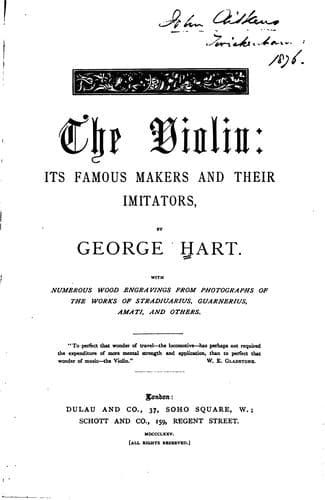
The Violin: Its Famous Makers and Their ImitatorsHart, George
History
The Violin: Its Famous Makers and Their Imitators
Hart, George
Violin -- History; Violin makers -- Biography
Others contented themselves with copying, without giving any place to
their fancy. It will be found that many of the instruments by Boquay,
Pierray, and a few others, have varnish upon them closely resembling
that of the Venetian school; it is full-bodied, very transparent, and
rich in colour. Many of their works are covered with a very inferior
quality of varnish, which has caused some confusion respecting the
merit due to them as varnishers, they being frequently judged by their
inferior instruments, without reference to their good ones. It is
evident that they made two qualities of varnish, in accordance with
the price they were to obtain, as was commonly done in England by the
Forsters, Banks, and Wamsley, where similar confusion exists. The
Italians happily avoided this objectionable practice. Their works are
of one uniform quality in point of varnish. This divergence may
possibly be accounted for by the difference of climate. In Italy, oil
varnish, judiciously used, would dry rapidly, whereas in France or
England the reverse would be the case; hence its more sparing use.
We will now glance at the second French School of makers, commencing
with De Comble. Learning his art in Italy, and, it is said, under
Stradivari, he brought to bear a knowledge superior to that possessed
by the makers mentioned above. The form he introduced was seen to be
in advance of that hitherto met with among the French and Belgian
makers, and led to its being chiefly followed. The next maker was
Pique, who made Violins and Violas that were excellent in point of
workmanship, and had he been equally successful in varnishing he would
probably have been held in the same estimation as Nicolas Lupot. From
these makers sprang quite a little school of its own, comprising
Francois Gand, in Paris, who succeeded to the business of Lupot, and
Bernardel, with several others less known. Mention must not be omitted
of another excellent copyist--Silvestre, of Lyons. He has left some
charming specimens of his art. They are lighter in character than the
works of Nicolas Lupot, and resemble the work of Stradivari from 1680
to 1710. Every portion of the work evidences the skill and judgment of
the maker. The wood, with scarcely an exception, has not been
manipulated in order to darken it, consequently the instruments become
of increasing merit as age acts upon them.
Public-domain text, read in full here on John Shaqi.
Reviews
Reviews
No reviews yet
Be the first to share your thoughts on this work.
Elsewhere in the archive
Join the Discussion
Join the discussion
Sign in to leave a comment or review.
Sign InorCreate an account