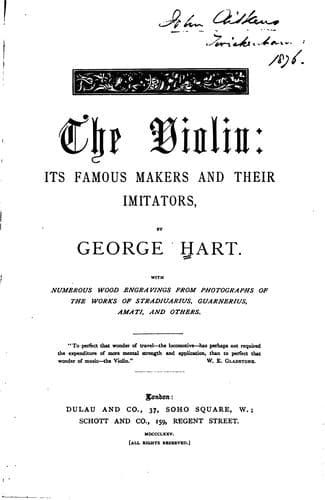
The Violin: Its Famous Makers and Their ImitatorsHart, George
History
The Violin: Its Famous Makers and Their Imitators
Hart, George
Violin -- History; Violin makers -- Biography
The practice of preparing the wood for Violin-making, either by baking
it or by the application of acids, may be traced, in the first
instance, to a desire to obtain artificially those results which are
brought about by the hand of time. In obtaining lightness and dryness
in new wood, it was imagined that the object in view would be reached
without the aid of Dame Nature. Experience, however, has shown that
Fiddles, like all things intended to pass into green old age, mature
gradually, and are not to be benefited by any kind of forcing process.
The earliest account I have met with of Fiddle-baking occurred in
England about 150 years since. One Jeacocke, a baker by trade, and a
lover of music by nature, used to bake his Fiddles in sawdust for a
week whenever their tones showed symptoms of not being up to his
standard of quality. In France the practice may be said to have been
introduced about eighty years ago, with a view of facilitating the
creation of such mysteries as Duiffoprugcar and Morella Violins, baked
and browned until they had something of a fifteenth-century hue. The
same means were adopted in the production of instruments intended as
copies of the works of Stradivari and Guarneri. The brown hue of the
originals, and the worn and broken condition of the varnish which
comes of age alone, were imitated with more or less ingenuity. Happily
the error is recognised, as far as the best workmanship is concerned,
in France. The legitimate imitator's art no longer includes that of
depicting wear and brownness, rendering abortive so much excellent
work.
Public-domain text, read in full here on John Shaqi.
Reviews
Reviews
No reviews yet
Be the first to share your thoughts on this work.
Elsewhere in the archive
Join the Discussion
Join the discussion
Sign in to leave a comment or review.
Sign InorCreate an account