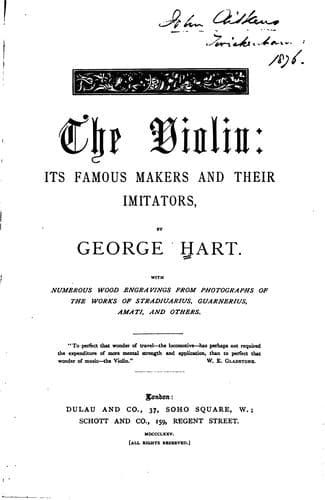
The Violin: Its Famous Makers and Their ImitatorsHart, George
History
The Violin: Its Famous Makers and Their Imitators
Hart, George
Violin -- History; Violin makers -- Biography
In the archives of the town and salt mines at Hall, Herr Ruf found
much information, which he published in the local newspapers, the
ephemeral nature of which naturally placed his valuable contributions
beyond the reach of those likely to value them. In the meantime
Nicolaus Diehl, of Hamburg, published a little book on Violins, into
which was imported a portion of the romance traceable to the novels or
poems on Stainer. Herr Ruf, feeling disappointed that his labours in
discovering the facts relative to Stainer had failed to clear away the
cloud of Stainer fiction, published in 1872 his book, "Der
Geigenmacher Jacob Stainer von Absam in Tirol," which gives us a full
account of his researches, and should have secured to him the full
credit due to his industry. His facts, however, like the good fiction
found in Dr. Schuler's novel, "Jacob Stainer," have been used by
German writers on the subject of the Violin without any
acknowledgment. Herr Ruf died at Hall in the year 1877.
It is said that Stainer was apprenticed to an organ-builder at
Innsbruck, but owing to his weak constitution he was unable to
continue in the business, and chose instead the trade of
Violin-making. Amongst the rumours concerning this maker may be
mentioned that of his having been a pupil of Niccolo Amati. It is
certain there is no direct evidence in support of it, neither is it
shown that his work is founded on that of Amati. I am satisfied that
Stainer was assisted neither by the Brothers Amati nor Niccolo Amati,
and I am strengthened in this opinion by the steadfastly German
character of a model which no pupil of Amati could have persisted in
using, even though based on his earliest traditions.
The marriage of Stainer took place October 7, 1645. On the 9th of
October, 1658, he was appointed by the Archduke Leopold (of Austria,
Governor of Tyrol) one of the "archducal servants," and on the 9th of
January, 1669, he obtained from the Emperor the title of "Violin-maker
to the Court." About this period he is said to have incurred the
displeasure of the Jesuits, which led to his being accused of the
crime of heresy. The accusation seems to have been based on the fact
of books of a controversial kind--chiefly Lutheran--having been found
in his possession. The penalty he suffered for daring to indulge in
polemical literature was six months' imprisonment, and his future
prospects were completely shattered. Prior to this misfortune he
appears to have been in pecuniary difficulties, and frequently at law
with one Salomon Hubmer, of Kirzchdorf, from whom he had obtained
money loans. In the year 1677 he petitioned the Emperor Leopold--who
was a great patron and lover of music--to render him pecuniary
assistance, but failed to procure it. Over-burdened with troubles, he
was bereft of his reason, and died insane and insolvent in the year
1683.
"Alas! misfortunes travel in a train,
And oft in life form one perpetual chain."
Public-domain text, read in full here on John Shaqi.
Reviews
Reviews
No reviews yet
Be the first to share your thoughts on this work.
Elsewhere in the archive
Join the Discussion
Join the discussion
Sign in to leave a comment or review.
Sign InorCreate an account