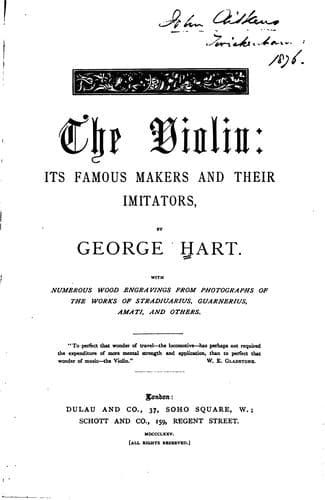
The Violin: Its Famous Makers and Their ImitatorsHart, George
History
The Violin: Its Famous Makers and Their Imitators
Hart, George
Violin -- History; Violin makers -- Biography
FENDT, Bernard, born at Innsbruck, in the Tyrol, 1756, died 1832. He
was evidently a born Fiddle-maker, genius being stamped, in a greater
or less degree, upon all his works. To Thomas Dodd belongs the credit
of bringing his talent into play. Dodd obtained the services of Fendt
upon his arrival in England, which the latter reached at an early age.
He remained with Dodd many years, frequently making instruments with
John Frederick Lott. The instruments so made bear the label of Thomas
Dodd. Lott being also a German, reciprocity of feeling sprung up
between him and Fendt, which induced Lott to exchange the business to
which he was brought up for that which his fellow countryman Fendt had
adopted, and henceforth to make Violins instead of cabinets. By
securing the services of these admirable workmen, Dodd reaped a rich
harvest. He found in them men capable of carrying out his instructions
with an exactness that could not be surpassed. Dodd was unable to use
the tools himself; but in Fendt and Lott he had men who were
consummate masters of them. When the instruments were finished, as far
as construction was concerned, they were clothed in coats of the
master's livery--"Dodd's varnish," the secret of making which he kept
carefully to himself. With these coats of varnish upon them the work
was doubly effective, and every point of excellence was made to shine
with the happiest effect. Upon leaving the workshop of Thomas Dodd,
Bernard Fendt worked for John Betts, making many of those copies of
Amati which are associated with the name of Betts, and which have so
high a value.
Although Fendt was German by birth, his style of work cannot be
considered as German in character. Having early quitted his post of
trade in Paris for England, and having in this country placed himself
under the guidance of Dodd, who steadfastly kept before his workmen
the originals of the great Italian masters for models, his work
acquired a distinctive stamp of its own, and in its turn gave rise to
a new and independent class of makers.
Public-domain text, read in full here on John Shaqi.
Reviews
Reviews
No reviews yet
Be the first to share your thoughts on this work.
Elsewhere in the archive
Join the Discussion
Join the discussion
Sign in to leave a comment or review.
Sign InorCreate an account