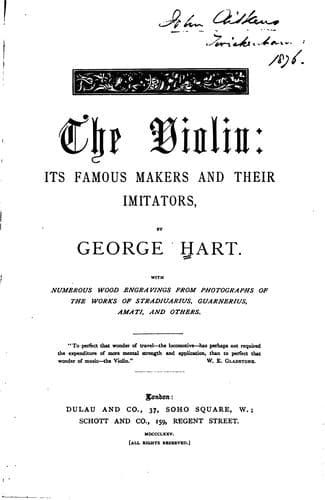
The Violin: Its Famous Makers and Their ImitatorsHart, George
History
The Violin: Its Famous Makers and Their Imitators
Hart, George
Violin -- History; Violin makers -- Biography
FENDT, Bernard Simon, London, born in 1800, died in 1852. Son of the
above. He was an excellent workman. It is to be regretted that he did
not follow the excellent example set by his father, and let time do
its work, without interruption, upon his instruments. Had he done so
they would, in many instances, have been equal to those of his parent;
but, unfortunately, he worked when the mania for obtaining supposed
maturity by artificial means was at its height, and shared the general
infatuation, and, in consequence, very frequently destroyed all the
stamina of his instruments. Subsequently he became a partner of George
Purdy, and carried on a joint business at Finch Lane, in the City of
London, from whence most of his best instruments date. Purdy and Fendt
had also a shop in the West End about 1843. He was a most assiduous
worker. The number of Violins, Tenors, Violoncellos, and Double-Basses
that he made was very great; indeed, his reputation would have been
greater had he been content to have made fewer instruments and to have
exercised more general care. His copies of Guarneri are most numerous,
numbering some hundreds. They are mostly varnished with a glaring red
colour, of a hard nature. He made many good Double-Basses of the
Gasparo da Salo form, the varnish on which is superior to that on his
Violins. He made also an excellent quartette of instruments--Violin,
Viola, Violoncello, and Double-Bass--for the Exhibition of 1851. They
were certainly the best contemporary instruments exhibited, but he
failed to obtain the prize medal.
FENDT, Martin, London, born 1812, died 1845. Brother of the above.
Worked for Betts.
FENDT, Jacob, London, born 1815, died 1849. Third son of Bernard
Fendt. The best maker among the sons of Bernard. His instruments are
beautifully finished, and free from the stereotyped character
belonging to those of his brother Bernard. As specimens of the
imitator's art they are unsurpassed. One cannot but regret that such a
consummate workman should have been obliged to waste his energies in
making new work resemble that of a hundred years before. The patronage
that he obtained was not of much value, but had he brought his work
into the market in its natural condition he could not have lived by
his trade. He was, therefore, compelled to foster that which he no
doubt felt to be degrading. The copies of Stradivari by Jacob Fendt
are among his best efforts. The work is well done; the discoloration
of the wood cleverly managed, the effects of wear counterfeited with
greater skill than had ever been done before, and finally, an amount
of style is thrown into the work which transcends the ingenuity of any
other copyist. Had he been allowed to copy the form of the old
masters, as Lupot did, without imitating the actual wear of the
instrument, we should have had a valuable addition to our present
stock of instruments of the Panormo class.
FENDT, Francis, London. Fourth son of Bernard; also worked in
Liverpool about 1856.
Public-domain text, read in full here on John Shaqi.
Reviews
Reviews
No reviews yet
Be the first to share your thoughts on this work.
Elsewhere in the archive
Join the Discussion
Join the discussion
Sign in to leave a comment or review.
Sign InorCreate an account