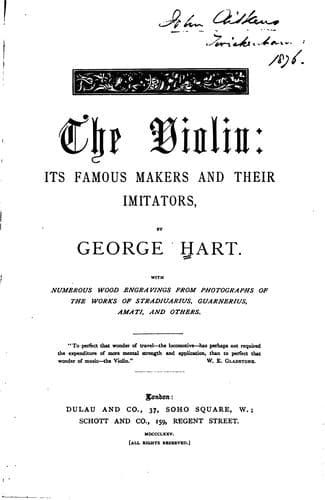
The Violin: Its Famous Makers and Their ImitatorsHart, George
History
The Violin: Its Famous Makers and Their Imitators
Hart, George
Violin -- History; Violin makers -- Biography
The fancy for the Violin as a curiosity has been a matter of slow
growth, and has reached its present proportions solely from the
intrinsic merits of its object. The Violin has not come suddenly to
occupy the attention of the curious, like many things that might be
named, which have served to satisfy a taste for the collection of what
is rare or whimsical, and to which an artificial value has been
imparted. In those days when the old Brescian and Cremonese makers
flourished, the only consideration was the tone-producing quality of
their instruments; the Violin had not then taken its place among
curiosities. The instruments possessing the desired qualities were
sought out until their scarcity made them legitimate food for the
curious. Beauties, hitherto passed over, began to be appreciated, the
various artistic points throughout the work of each valued maker were
noted, and in due time Violins had their connoisseurs as well as their
players.
Besides Italy, England, France, and Germany have had their great men
in the Fiddle world, whose instruments have ever been classed as
objects of _virtu_. Mace, in his "Musick's Monument," published in
1676, gives, perhaps, the earliest instance of curiosity prices in
England. "Your best provision (and most compleat) will be a good chest
of Viols; six in number, viz., two Basses, two Tenors, and two
Trebles, all truly and proportionally suited; of such there are no
better in the world than those of Aldred, Jay, Smith; (yet the highest
in esteem are) Bolles and Ross (one Bass of Bolles I have known valued
at 100 pounds). These were old." From the above curious extract we
glean that the Fiddle family was receiving some attention. The makers
in England whose instruments seem to have reached curiosity prices are
Bolles, Jay, Barak Norman, Duke, Wamsley, Banks, and Forster: the
value attached at different periods to the works of these men has
nearly approached the prices of Cremonese work. Of course, the high
value set upon the instruments of the makers above named was confined
to England.
Turning to France, we find that many of the old French makers'
instruments brought prices greatly in excess of their original cost.
The favourite French makers were Medard, Boquay, Pierray, of the old
school, and Lupot and Pique of the modern.
Public-domain text, read in full here on John Shaqi.
Reviews
Reviews
No reviews yet
Be the first to share your thoughts on this work.
Elsewhere in the archive
Join the Discussion
Join the discussion
Sign in to leave a comment or review.
Sign InorCreate an account