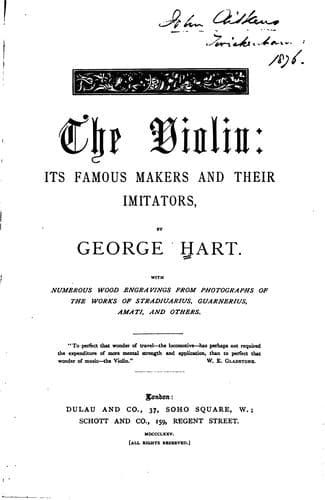
The Violin: Its Famous Makers and Their ImitatorsHart, George
History
The Violin: Its Famous Makers and Their Imitators
Hart, George
Violin -- History; Violin makers -- Biography
In Germany there have been makers whose works have brought very high
prices. Stainer, Albani, Widhalm, Scheinlein, are names that will
serve to associate high values with German work. In the case of Jacob
Stainer, the celebrity of his instruments was not confined to Germany;
they were highly prized by the English and French, and at one period
were more valued than the best Amatis. It was not until the vast
superiority of Italian Violins over all others was thoroughly
recognised, that the love of the instrument as a curiosity reached its
present climax. In Italy, the value set upon the chief Cremonese
works, though great, was comparatively insignificant, as far as the
Italians themselves are concerned, and when France and England came
into competition with them for the possession of their Violins by
Amati, Stradivari, Guarneri, and the gems of other makers, they at
once yielded the contest.
The introduction of Italian instruments into Great Britain was a
matter of slow growth, and did not assume any proportions worthy of
notice until the commencement of the present century, when London and
Paris became the chief marts from whence the rare works of the old
Italians were distributed over Europe. By this time the taste of the
Fiddle world had undergone a considerable change. The instruments in
use among the _dilettanti_ in France and England had hitherto been
those built on the German model of the school of Jacob Stainer. The
great German maker was copied with but little intermission for upwards
of a century, dating from about 1700 to 1800, a period of such
considerable extent as to evidence the popularity of the model. Among
the Germans who were following in the footsteps of Stainer were the
family of Kloz, Widhalm, Statelmann, and others of less repute. In
England there was quite an army of Stainer-worshippers. There were
Peter Wamsley, Barrett, Benjamin Banks, the Forsters, Richard Duke,
and a whole host of little men. Among the makers mentioned there are
three, viz., Banks, Forster, and Richard Duke, who did not copy
Stainer steadfastly. Their early instruments are of the German form,
but later they made many copies of the Cremonese. To Benjamin Banks we
are indebted for having led the English makers to adopt the pattern of
Amati. He had long laboured to popularise the school which he so much
loved, but met with little encouragement in the beginning, so strong
was the prejudice in favour of the high model. However, he triumphed
in the end, and completely revolutionised the taste in England, till
our Fiddle-fanciers became total ab-_Stainers_! Then commenced the
taste for instruments of flat form. Where were they to be found? If
the few by the early English makers be excepted, there were none but
those of the Italians to be had, and perhaps a few old French
specimens. Attention was thus directed to the works of the Cremonese,
and the year 1800 or thereabouts may be put down as the time when the
Public-domain text, read in full here on John Shaqi.
Reviews
Reviews
No reviews yet
Be the first to share your thoughts on this work.
Elsewhere in the archive
Join the Discussion
Join the discussion
Sign in to leave a comment or review.
Sign InorCreate an account