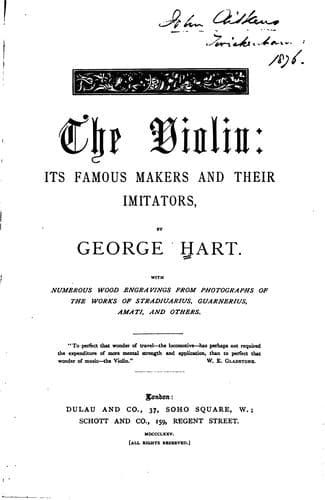
The Violin: Its Famous Makers and Their ImitatorsHart, George
History
The Violin: Its Famous Makers and Their Imitators
Hart, George
Violin -- History; Violin makers -- Biography
tide of Italian Violins had fairly set in towards France and England.
The instruments by the Amati were those chiefly sought after; the
amount of attention they commanded at this period was probably about
equal to that bestowed upon the works of Stradivari and Guarneri at
the present time. Violins of Amati and other makers were, up to this
time, obtainable at nominal prices. The number in Italy was far in
excess of her requirements, the demand made upon them for choir
purposes in former days had ceased, and the number of Violins was thus
quite out of proportion to the players. The value of an Amati in
England in 1799 and 1804 may be gathered from the following extracts
from the day-book of the second William Forster, who was a dealer as
well as maker--"20th April, 1799. A Violoncello by Nicholas Amati,
with case and bow, 17 pounds 17s. 0d.;" and further on--"5th July,
1804, an Amati Violin 31 pounds 10s. 0d." These prices were probably
less than those which William Forster received for many instruments of
his own make. It is certain that these low prices did not long
continue; the price increased in due proportion to the vanishing
properties of the supply. The call for Violins by the Amati was so
clamorous as speedily to effect this result; the prices for them were
doubled, trebled, and often quadrupled, until they no longer found a
home in their native land. The value set on them by the French and
English so far exceeded that which the Italians themselves could
afford, even though inclined to indulge in such things, that the
sellers were as eager to sell as the buyers to buy. During the time of
this scramble for instruments of Cremona, the theory of the flat model
was fast gaining ground. The circulation of the works of Cremona among
the players of France and England led to a comparison of the various
forms, and it was found that the elevated model was inferior in every
way when tested by the works of the great Italian makers. Hitherto no
distinction had been drawn as regards value among the productions of
the several members of the Amati family. Andrea had been looked upon
as equivalent to Girolamo, Antonio, or Niccolo; but attention now
began to be directed towards the works of the brothers, and to those
of Niccolo in particular, as the flat model gained in the appreciation
of the Fiddling world. Grand Amatis became the coveted Fiddles; they
were put up frequently at twice the value of the smaller patterns--a
position they still maintain. The taste for the flat form having thus
been developed, the works of Antonio Stradivari came to the front,
slowly but surely; their beauties now became known outside the circle
in which they had hitherto been moving: a circle made up chiefly of
royal orchestras (where they were used at wide intervals), convent
choirs, and private holders, who possessed them without being in the
least aware of their merits. They were now eagerly sought by soloists
in all parts of Europe, who spread their fame far and wide.
Public-domain text, read in full here on John Shaqi.
Reviews
Reviews
No reviews yet
Be the first to share your thoughts on this work.
Elsewhere in the archive
Join the Discussion
Join the discussion
Sign in to leave a comment or review.
Sign InorCreate an account