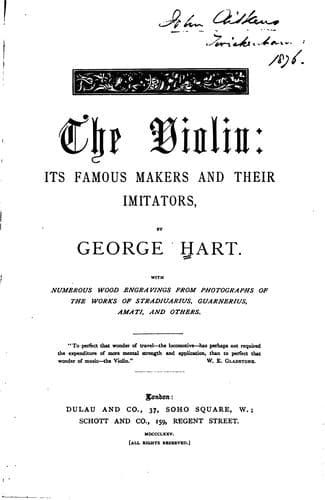
The Violin: Its Famous Makers and Their ImitatorsHart, George
History
The Violin: Its Famous Makers and Their Imitators
Hart, George
Violin -- History; Violin makers -- Biography
before bringing forth his treasures. It is said that he undertook his
journey on foot, depriving himself often of the common necessaries of
life, that he might have more money to buy up his country's Fiddles.
His first visit to Paris was in 1827, an eventful year in the history
of Italian Violins, as far as relates to Paris. Upon arriving in the
French capital, he directed his steps to the nearest luthier, one
Aldric, to whom he had been recommended as a purchaser of old
instruments of high value. Upon arriving at the shop of M. Aldric,
Tarisio hesitated before entering, feeling suddenly that his
appearance was scarcely in keeping with his wares, his clothes being
of the shabbiest description, his boots nearly soleless, and his
complexion, naturally inclined to blackness, further darkened by the
need of ordinary ablutions. However, he set aside these thoughts, and
introduced himself to the luthier as having some Cremona Violins for
sale. Aldric regarded him half-contemptuously, and with a silent
intent to convey to Tarisio that he heard what he said, but did not
believe it. The Italian, to the astonishment of the luthier, was not
long in verifying his statement; he opened his bag and brought forth a
beautiful Niccolo Amati, of the small pattern, in fine preservation,
but having neither finger-board, strings, nor fittings of any kind.
The countenance of the luthier brightened when he beheld this
unexpected specimen of the Italian's wares. He carefully examined it,
and did his best to disguise the pleasurable feelings he experienced.
He demanded the price. The value set on it was far in excess of that
he had anticipated; he erroneously arrived at the probable cost from
an estimate of the shabby appearance of the man. He had been
comforting himself that the Italian was unaware of the value put upon
such instruments. He decided to see further the contents of the bag
before expressing an opinion as to the price demanded for the Amati.
Violins by Maggini, Ruggeri, and others, were produced--six in number.
Tarisio was asked to name his price for the six. After much giving and
taking they became the property of the luthier. This business was not
regarded as satisfactory by Tarisio; he had overestimated the value of
his goods in the Paris market; he had not learned that it was he
himself who was to create the demand for high-class Italian
instruments by spreading them far and wide, so that their incomparable
qualities might be observed. He returned to Italy with his ardour
somewhat cooled; the ready sale at the prices he had put upon his
stock was not likely to be realised, he began to think. However, with
the proceeds of his Paris transaction he again started in search of
more Cremonas, with about the same satisfactory results. He resolved
to visit Paris again, taking with him some of his choicest specimens.
He reached the French capital with a splendid collection--one that in
these days would create a complete _furore_ throughout the world of
Fiddles.
Public-domain text, read in full here on John Shaqi.
Reviews
Reviews
No reviews yet
Be the first to share your thoughts on this work.
Elsewhere in the archive
Join the Discussion
Join the discussion
Sign in to leave a comment or review.
Sign InorCreate an account