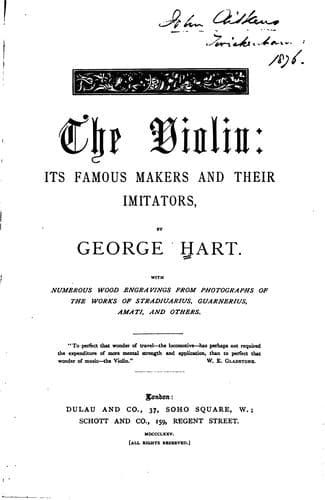
The Violin: Its Famous Makers and Their ImitatorsHart, George
History
The Violin: Its Famous Makers and Their Imitators
Hart, George
Violin -- History; Violin makers -- Biography
He extended his acquaintance with the Parisian luthiers,
among whom were MM. Vuillaume, Thibout, and Chanot senior. They were
all delighted with the gems that Tarisio had brought, and encouraged
him to bring to France as many more as he could procure, and at
regular intervals. He did so, and obtained at each visit better
prices.
[Illustration: _Plate XX_. GASPARO DA SALO. (LATE LORD AMHERST OF
HACKNEY.) GIUSEPPE GUARNERI DEL GESU. 1735. (PRINCE FREDERICK WILLIAM
OF PRUSSIA.)]
This remarkable man may be said to have lived for nought else but his
Fiddles. Mr. Charles Reade, who knew him well, says:[1] "The man's
whole soul was in Fiddles. He was a great dealer, but a greater
amateur; he had gems by him no money would buy from him." It is
related of him that he was in Paris upon one occasion, walking along
the Boulevards with a friend, when a handsome equipage belonging to a
French magnate passed, the beauty of which was the talk of the city.
Tarisio's attention being directed to it by his friend, he calmly
answered him that "_he would sooner possess one 'Stradivari' than
twenty such equipages_." There is a very characteristic anecdote of
Tarisio, which is also related by Mr. Reade in his article on Cremona
Violins, entitled the "Romance of Fiddle-dealing":
"Well, one day Georges Chanot, senior, made an excursion to Spain, to
see if he could find anything there. He found mighty little, but
coming to the shop of a Fiddle-maker, one Ortega, he saw the belly of
an old Bass hung up with other things. Chanot rubbed his eyes, and
asked himself was he dreaming? the belly of a Stradivari Bass roasting
in a shop window! He went in, and very soon bought it for about forty
francs. He then ascertained that the Bass belonged to a lady of rank.
The belly was full of cracks; so, not to make two bites of a cherry,
Ortega had made a nice new one. Chanot carried this precious fragment
home and hung it up in his shop, but not in the window, for he was too
good a judge not to know that the sun will take all the colour out of
that maker's varnish. Tarisio came in from Italy, and his eye lighted
instantly on the Stradivari belly. He pestered Chanot till the latter
sold it him for a thousand francs, and told him where the rest was.
Tarisio no sooner knew this than he flew to Madrid. He learned from
Ortega where the lady lived, and called on her to see it. 'Sir,' says
the lady, 'it is at your disposition.' That does not mean much in
Spain. When he offered to buy it, she coquetted with him, said it had
been long in her family; money could not replace a thing of that kind,
and, in short, she put on the screw, _as she thought_, and sold it him
for about four thousand francs. What he did with the Ortega belly is
not known; perhaps sold it to some person in the toothpick trade. He
sailed exultant for Paris with the Spanish Bass in a case. He never
let it go out of his sight. The pair were caught by a storm in the Bay
Public-domain text, read in full here on John Shaqi.
Reviews
Reviews
No reviews yet
Be the first to share your thoughts on this work.
Elsewhere in the archive
Join the Discussion
Join the discussion
Sign in to leave a comment or review.
Sign InorCreate an account