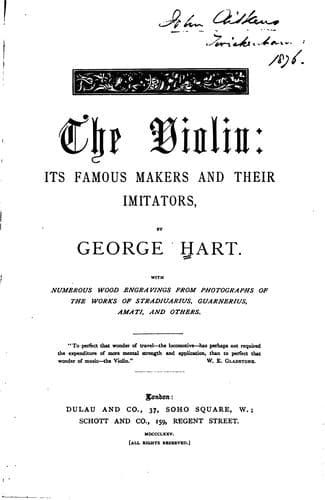
The Violin: Its Famous Makers and Their ImitatorsHart, George
History
The Violin: Its Famous Makers and Their Imitators
Hart, George
Violin -- History; Violin makers -- Biography
[Footnote 2: Lulli having shown a disposition for music, received some
instructions on the rudiments of the art from a priest. The Chevalier
de Guise, when on his travels in Italy, had been requested by
Mademoiselle de Montpensier, niece of Louis XIV., to procure for her
an Italian boy as page, and happening to see Lulli in Florence, he
chose him for that purpose, on account of his wit and vivacity, and
his skill in playing on the guitar. The lady, however, not liking his
appearance, sent him into her kitchen, where he was made an under
scullion, and amused himself by arranging the stew-pans in tones and
semitones, upon which he would play various airs, to the utter dismay
of the cook.]
Lulli contributed greatly to the improvement of French music. He wrote
several operas, and many compositions for the Church, all of which
served to raise the standard of musical taste in France. To him also
belongs the credit of having founded the French national opera.
We will now endeavour to trace the progress of the Violin in England.
It is gratifying to learn that, even in the primitive age of
Violin-playing, we were not without our national composers for the
instrument. Dr. Benjamin Rogers wrote airs in four parts for Violins
so early as 1653 (the year Corelli was born). John Jenkins wrote
twelve sonatas for two Violins and a Bass, printed in London in 1660,
which were the first sonatas written by an Englishman. About this date
Charles II. established his band of twenty-four Violins. During his
residence on the Continent he had frequent opportunities of hearing
the leading instrument, and seems to have been so much impressed with
its beauties that he set up for himself a similar band to that
belonging to the French Court. The leader was Thomas Baltzar, who was
regarded as the best player of his time. Anthony Wood met Baltzar at
Oxford, and says he "saw him run up his fingers to the end of the
finger-board of the Violin, and run them back insensibly, and all in
alacrity and in very good time, which he nor any one in England saw
the like before." Wood tells us that Baltzar "was buried in the
cloister belonging to St. Peter's Church in Westminster." The
emoluments attached to the Royal band, according to Samuel Pepys,
appear to have been somewhat irregular. In the Diary, December 19,
1666, we read: "Talked of the King's family with Mr. Kingston, the
organist. He says many of the musique are ready to starve, they being
five years behindhand for their wages; nay, Evens, the famous man upon
the Harp, having not his equal in the world, did the other day die for
mere want, and was fain to be buried at the alms of the parish, and
carried to his grave in the dark at night without one linke, but that
Mr. Kingston met it by chance, and did give 12d. to buy two or three
links."
Public-domain text, read in full here on John Shaqi.
Reviews
Reviews
No reviews yet
Be the first to share your thoughts on this work.
Elsewhere in the archive
Join the Discussion
Join the discussion
Sign in to leave a comment or review.
Sign InorCreate an account