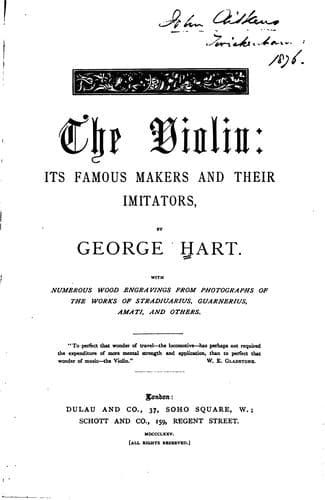
The Violin: Its Famous Makers and Their ImitatorsHart, George
History
The Violin: Its Famous Makers and Their Imitators
Hart, George
Violin -- History; Violin makers -- Biography
The state of the Merry Monarch's exchequer in 1662, according to an
extract from the Emoluments of the Audit Office, seems to have been
singularly prosperous. An order runs as follows: "These are to require
you to pay, or cause to be paid, to John Bannister, one of His
Majesty's musicians in ordinary, the sum of forty pounds for two
Cremona Violins, by him bought and delivered for His Majesty's
service, as may appear by the bill annexed; and also ten pounds for
strings for two years ending 24th June, 1662."
The King's band was led in 1663 by the above-named John Bannister, who
was an excellent Violinist. His name is associated with the earliest
concerts in England, namely, those held at "four of the clock in the
afternoon" at the George Tavern, in Whitefriars. Roger North informs
us the shopkeepers and others went to sing and "enjoy ale and
tobacco," and the charge was one shilling and "call for what you
please."
In the year 1683, Henry Purcell, organist of the Chapel Royal,
published twelve sonatas for two Violins and a Bass. These famous
instrumental compositions were written, the author tells us, in "just
imitation of the most famed Italian masters, principally to bring the
seriousness and gravity of that sort of musick into vogue." Purcell,
in conformity with an age of dedications, thus addressed the Merry
Monarch:--
"May it please your Majesty, I had not assum'd the confidence of
laying ye following compositions at your sacred feet, but that, as
they are the immediate results of your Majestie's Royal favour and
benignity to me (which have made me what I am), so I am constrained to
hope I may presume amongst others of your Majestie's over-obliged and
altogether undeserving subjects that your Majesty will, with your
accustomed clemency, vouchsafe to pardon the best endeavours of your
Majestie's
"Most humble and obedient subject and servant,
"H. PURCELL."
Charles II. is said to have understood his notes, and to sing in (in
the words of one who had sung with him) a plump bass, but that he only
looked upon music as an incentive to mirth, not caring for any that he
could not "stamp the time to." The endeavour of his accomplished and
gifted young organist to lead the King and his people to admire what
he terms "the seriousness and gravity" of Italian music, and "to
loathe the levity and balladry of our neighbours," was indeed worthy
of England's greatest musician.
In the year 1678, Thomas Britton, known as the "musical small-coal
man," gave concerts in this country, and a long series it was,
extending over a period of forty-six years. The shape the movement
took was that of a musical club, which was maintained at Britton's
expense.
The concert-room of Tom Britton was over his coal-shop in Aylesbury
Street, leading from Clerkenwell Green to St. John Street. From the
year 1678 to the time of his death, in 1714, the concerts of Britton
were attended by persons of all ranks.
Public-domain text, read in full here on John Shaqi.
Reviews
Reviews
No reviews yet
Be the first to share your thoughts on this work.
Elsewhere in the archive
Join the Discussion
Join the discussion
Sign in to leave a comment or review.
Sign InorCreate an account