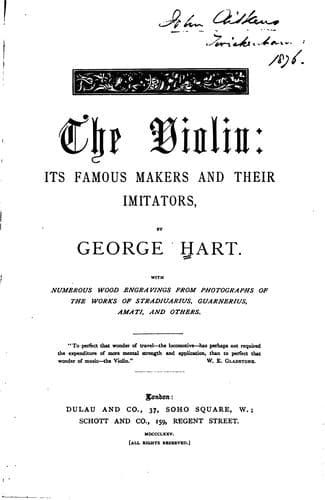
The Violin: Its Famous Makers and Their ImitatorsHart, George
History
The Violin: Its Famous Makers and Their Imitators
Hart, George
Violin -- History; Violin makers -- Biography
That the Spanish were influenced by their Moorish conquerors with
regard to music, minstrelsy, and dancing is certain. The origin of
such movements as the Saraband, the Morisca (or Morris dance), and the
Chaconne,[10] has been traced to the East. That such dances should
have been accompanied by instruments of Eastern origin of the Lute
kind may be assumed. Both in Spain and southern France accompanying
instruments struck with plectra or twanged with the fingers were
adopted at a very early period, and the people of those parts attained
to a high state of proficiency--so much so indeed as to have rendered
the cultivation of this description of music a national characteristic
with them in the use of such instruments. The usage of the bow,
however, does not appear to have been cultivated sufficiently, if at
all, to leave its traces in history, until about the twelfth century,
when the Troubadours sought the aid of the Trouveres and Jongleurs.
The Trouveres were minstrel poets belonging to Northern France. The
Jongleurs entertained their patrons with jests and arch sayings, and
were often joined by the Gigeours of Germany, to accompany their lays
with their Geigen and kindred instruments.
[Footnote 10: It need scarcely be said that the Eastern and Spanish
ancestor of Bach's Chaconne was terpsichorean, and was unconnected
with any kind of scientific musical treatment.]
The foregoing remarks point to the absence of reliable evidence of the
existence of a bow--worthy of the name from the point of view of a
Violinist--among the Asiatic nations in the early centuries of our
era. The Ravanastron of India, the Rebab of Arabia, and other stringed
instruments used by the Persians and the Chinese, hardly admit of
being looked upon as links in the genealogical Fiddle chain. Whatever
the shape and use of ancient Eastern instruments--having something in
common with the European Violin--may have been, the slight apparent
affinity is accidental, and no real relationship exists between the
European and the Asiatic Fiddle.[11]
[Footnote 11: Mr. Engel, "Researches into the Early History of the
Violin Family," page 104, remarks: "It is rarely that the name of an
Asiatic musical instrument can be traced to a European origin. There
are, however, one or two instances in which this seems to be possible.
Thus, the Chinese name Ye-Yia, by which they occasionally designate
their Fiddle, may possibly be a corruption of _giga_ or _geige_,
considering that the common name of the Chinese Fiddle is Unheen, and
that Macao, where this instrument is said to be called Ye-Yin, has
been above three hundred years in the possession of the Portuguese,
and in constant communication with European nations." This seems to
deprive the argument of the Eastern origin of the Fiddle of weight,
and favours the already strong evidence of Scandinavian origin centred
in the word Geige.]
2.
Public-domain text, read in full here on John Shaqi.
Reviews
Reviews
No reviews yet
Be the first to share your thoughts on this work.
Join the Discussion
Join the discussion
Sign in to leave a comment or review.
Sign InorCreate an account