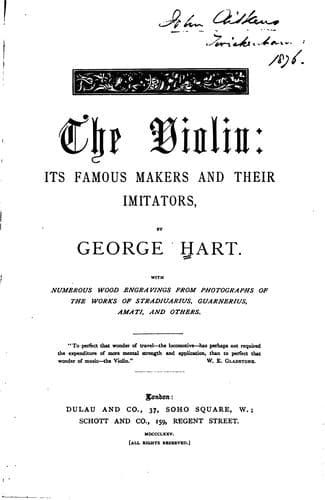
The Violin: Its Famous Makers and Their ImitatorsHart, George
History
The Violin: Its Famous Makers and Their Imitators
Hart, George
Violin -- History; Violin makers -- Biography
"Phillips, whose touch harmonious could remove
The pangs of guilty power or hapless love;
Rest here, distress'd by poverty no more;
Here find that calm thou gav'st so oft before;
Sleep undisturbed within this peaceful shrine,
Till angels wake thee with a note like thine!"
Boswell says, "Mr. Garrick appears not to have recited the verses
correctly, the original being as follows. One of the various readings
is remarkable, and it is the germ of Johnson's concluding line:--
"Exalted soul, thy various sounds could please
The love-sick virgin, and the gouty ease;
Could jarring _crowds_, like old Amphion, move
To beauteous order and harmonious love;
Rest here in peace, till angels bid thee rise,
And meet thy Saviour's _concert_ in the skies."
Boswell's "Journal of a Tour to the Hebrides" contains the author's
letter to Garrick asking him to send the "bad verses which led Johnson
to make his fine verses on Phillips the musician." Garrick replied,
enclosing the desired epitaph.
Boswell remarks, "This epitaph is so exquisitely beautiful that I
remember even Lord Kames, strangely prejudiced as he was against Dr.
Johnson, was compelled to allow it very high praise. It has been
ascribed to Garrick, from its appearing at first with the signature
G.; but I heard Mr. Garrick declare that it was written by Dr.
Johnson."
The epitaph of Phillips is in the porch of Wolverhampton Church. The
prose part of it is curious:--
Near this place lies
Charles Claudius Phillips,
Whose absolute contempt of riches,
and inimitable performances upon the Violin,
made him the admiration of all that knew him.
He was born in Wales,
made the tour of Europe,
and, after the experience of both kinds of fortune,
Died in 1732.
DR. JOHNSON'S KNOWLEDGE OF MUSIC.
He said he knew "a drum from a trumpet, and a bagpipe from a guitar,
which was about the extent of his knowledge of music." He further
tells us that "if he had learnt music he should have been afraid he
should have done nothing else but play. It was a method of employing
the mind, without the labour of thinking at all, and with some
applause from a man's self." These remarks are better appraised and
understood when we bear in mind Dr. Johnson's own estimate of his
musical knowledge together with his having derived pleasure from
listening to the sounds of the bagpipes. If a performance on those
droning instruments was in the Doctor's mind when he said that the
reflective powers need not be exercised in performing on a musical
instrument, there might be some truth in the observation. The labour
of thinking, however, cannot be dispensed with in connection with
playing most musical instruments, and least of all the Violin.
DR. JOHNSON ON FIDDLING AND FREE WILL.
Public-domain text, read in full here on John Shaqi.
Reviews
Reviews
No reviews yet
Be the first to share your thoughts on this work.
Elsewhere in the archive
Join the Discussion
Join the discussion
Sign in to leave a comment or review.
Sign InorCreate an account