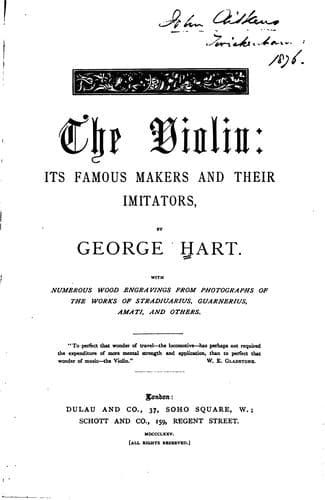
The Violin: Its Famous Makers and Their ImitatorsHart, George
History
The Violin: Its Famous Makers and Their Imitators
Hart, George
Violin -- History; Violin makers -- Biography
and single; if it be double, the wedge is bruised in pieces, and will
rend nothing." It may, therefore, be affirmed that the greatest
luminaries of the art world have shone most brightly under
circumstances in keeping with their peaceful labours, it not being
essential to success that men highly gifted for a particular art
should have this strength of will unless there were immediate call for
its exercise.
Judging from the large number of bow-instrument makers in Italy, more
particularly during the seventeenth century, we should conclude that
the Italians must have been considered as far in advance of the makers
of other nations, and that they monopolised, in consequence, the chief
part of the manufacture. The city of Cremona became the seat of the
trade, and the centre whence, as the manufacture developed itself,
other less famous places maintained their industry. In this way there
arose several distinct schools of a character marked and thoroughly
Italian, but not attaining the high standard reached by the parent
city. Notwithstanding the inferiority of the makers of Naples,
Florence, and other homes of the art as compared with the Cremonese,
they seem to have received a fair amount of patronage, the number of
instruments manufactured in these places of lesser fame being
considerable.
To enable the reader to understand more readily the various types of
Italian Violins, they may be classed as the outcome of five different
schools. The first is that of Brescia, dating from about 1520 to 1620,
which includes Gasparo da Salo, Maggini, and a few others of less
note. The next, and most important school, was that of Cremona, dating
from 1550 to 1760, or even later, and including the following makers:
Andrea Amati, Girolamo Amati, Antonio Amati, Niccolo Amati, Girolamo
Amati, son of Niccolo; Andrea Guarneri, Pietro Guarneri, Giuseppe
Guarneri, the son of Andrea; Giuseppe Guarneri ("del Gesu"), the
nephew of Andrea; Antonio Stradivari, and Carlo Bergonzi. Several
well-known makers have been omitted in the foregoing list simply
because they were followers of those mentioned, and therefore cannot
be credited with originality of design. The makers of Milan and Naples
may be braced together as one school, under the name of _Neapolitan_,
dating from 1680 to 1800. This school contains makers of good repute,
viz., the members of the Grancino family, Carlo Testore, Paolo
Testore, the Gagliano family, and Ferdinando Landolfi. The makers of
Florence, Bologna, and Rome may likewise be classed together in a
school that dates from 1680 to 1760, and includes the following names:
Gabrielli, Anselmo, Tecchler, and Tononi. The Venetian school, dating
from 1690 to 1764, has two very prominent members in Domenico
Montagnana and Santo Seraphino; but the former maker may, not
inappropriately, be numbered with those of Cremona, for he passed his
early years in that city, and imbibed all the characteristics
belonging to its chief makers.
Public-domain text, read in full here on John Shaqi.
Reviews
Reviews
No reviews yet
Be the first to share your thoughts on this work.
Join the Discussion
Join the discussion
Sign in to leave a comment or review.
Sign InorCreate an account