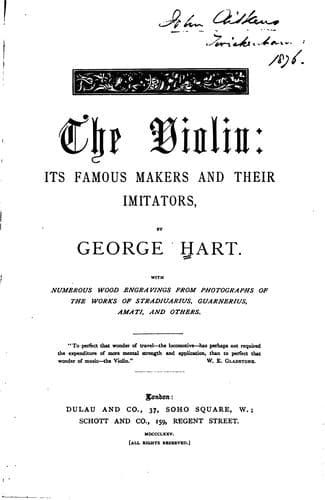
The Violin: Its Famous Makers and Their Imitators — John Shaqi
The Violin: Its Famous Makers and Their ImitatorsHart, George
History
The Violin: Its Famous Makers and Their Imitators
Hart, George
Violin -- History; Violin makers -- Biography
Declining, therefore, all speculation as to what the varnish is or
what it is not, or any nostrums for its re-discovery, we will pass on
at once to the description of the different Italian varnishes, which
may be divided into four distinct classes, viz., the Brescian,
Cremonese, Neapolitan, and Venetian. These varnishes are quite
separable in one particular, which is, the depth of their colouring;
and yet three of them, the Brescian, Cremonese, and Venetian, have to
all appearance a common basis. This agreement may be accounted for
with some show of reason by the supposition that there must have been
a depot in each city where the varnish was sold in an incomplete form,
and that the depth of colour used, or even the means adopted for
colouring, rested with the maker of the instrument. If we examine the
Brescian varnish, we find an almost complete resemblance between the
material of Gasparo da Salo and that of his coadjutors, the colouring
only being different. Upon turning to the Cremonese, we find that
Guarneri, Stradivari, Carlo Bergonzi, and a few others, used varnish
having the same characteristics, but, again, different in shade;
possibly the method of laying it upon the instrument was peculiar to
each maker. Similar facts are observable in the Venetian specimens.
The varnish of Naples, again, is of a totally different composition,
and as it was chiefly in vogue after the Cremonese was lost, we may
conclude that it was probably produced by the Neapolitan makers for
their own need.
If we reflect for a moment upon the extensive use which these makers
made of the Cremonese varnish, it is reasonable to suppose that it was
an ordinary commodity in their days, and that there was then no secret
in the matter at all. To account for its sudden disappearance and
total loss is, indeed, not easy. After 1760, or even at an earlier
date, all trace of it is obliterated. The demand for it was certainly
not so great as it had been, but quite sufficient to prevent the
supply from dying out had it been possible. The problem of its sudden
disappearance may, perhaps, be accounted for without overstepping the
bounds of possibility, if we suppose that the varnish was composed of
a particular gum quite common in those days, extensively used for
other purposes besides the varnishing of Violins, and thereby caused
to be a marketable article. Suddenly, we will suppose, the demand for
its supply ceased, and the commercial world troubled no further about
the matter. The natural consequence would be non-production. It is
well known that there are numerous instances of commodities once in
frequent supply and use, but now entirely obsolete and extinct.
Public-domain text, read in full here on John Shaqi.
Reviews
Reviews
No reviews yet
Be the first to share your thoughts on this work.
Join the Discussion
Join the discussion
Sign in to leave a comment or review.
Sign InorCreate an account