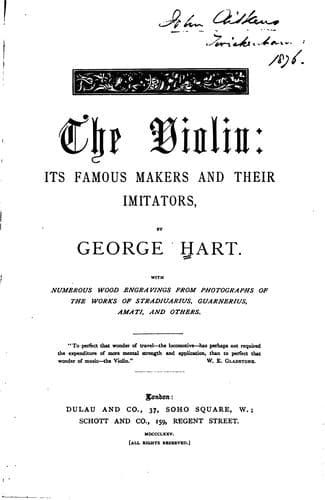
The Violin: Its Famous Makers and Their ImitatorsHart, George
History
The Violin: Its Famous Makers and Their Imitators
Hart, George
Violin -- History; Violin makers -- Biography
BODIO, G. B., Venice, about 1832. Good workmanship; oil varnish, wide
purfling.
BORELLI, Andrea, Parma, about 1735. His instruments are little known;
they resemble those of Giuseppe Guadagnini.
BRENSIO, Girolamo (BRENSIUS, Hieronymus), Bologna. Reference has been
made to the Viols of this maker in the first section of this work.
BRESCIA, Da, Battista. A Pochette or Kit of this maker is at the
Academy of Music, Bologna, signed "Baptista Bressano"; the period
assigned to it is the end of the 15th century.
BROSCHI, Carlo, Parma.
Carlo Broschi in Parma, fecit 1732.
BUSSETO, Giovanni M., Cremona, 1540-80. Maker of Viols. M. Fetis
mentions, in his "Biographie des Musiciens," that Busseto derived his
name from _Busseto_, a borough in the Duchy of Parma, where he was
born. He also mentions a Viol of this maker, dated 1580, which was
found at Milan in 1792.
CALCAGNI, Bernardo, Genoa, about 1740.
Bernardus Calcanius fecit Genuae
anno 17--
Neat workmanship, small scroll, flat model, well-cut sound-holes,
Stradivari pattern, orange-red varnish.
CALVAROLA, Bartolommeo, Bergamo, about 1753. The work is neatly
executed. These instruments are somewhat like those of Ruggeri in
form. The scroll is weak, and ill-proportioned.
CAMILLI, Camillo, Mantua, 17--.
Camillus Camilli Fecit Mantua 17--
The form partakes of that of Stradivari; wood usually of excellent
quality. The sound-hole is rather wide and short. The varnish
resembles that of Landolfi, but is less brilliant.
CAPPA, Gioffredo, Cremona, 1644-1717.
IOFREDVS CAPPA FECIT
SALVTIIS ANNO 16--
The dates of birth and death were ascertained by Dr. Orazio Roggiero,
a lawyer of Saluzzo, whose researches set at rest many doubts and
speculations as to this excellent maker and his period of activity. He
was formerly held to be a pupil of the brothers Amati, but the
assumption, having regard to the date of birth, is untenable.
The greater number of his productions consist of works of high merit.
Their likeness to the instruments of the Amati is in some instances
peculiarly striking, but in others there is a marked dissimilarity.
Particularly is this the case in the form of the sound-hole and
scroll. The sound-hole is sometimes large, and quite out of keeping
with the elegant outline of Amati. The points of difference may be
summed up as follows: the sound-hole is larger, and more obliquely set
in the instrument; the upper portion of the body has a more contracted
appearance; the head, as is the case with most makers, differs most,
and, in this instance, in no way resembles Amati.
Public-domain text, read in full here on John Shaqi.
Reviews
Reviews
No reviews yet
Be the first to share your thoughts on this work.
Elsewhere in the archive
Join the Discussion
Join the discussion
Sign in to leave a comment or review.
Sign InorCreate an account