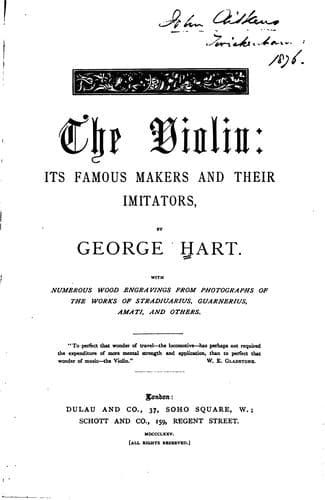
The Violin: Its Famous Makers and Their ImitatorsHart, George
History
The Violin: Its Famous Makers and Their Imitators
Hart, George
Violin -- History; Violin makers -- Biography
The sound-hole, also, of Guarneri always preserves its distinctive
character, and a grotesque humour which at once pleases the eye,
though it is found to vary considerably with the three periods of his
life. Again, the button--that portion of the back against which the
heel of the neck rests, which forms a prominent mark in all Violins,
and an evidence of style, has a remarkably pronounced development in
the Violins of Guarneri, and, in fact, may be said to give a vitality
to the whole work. There are many instances where excellent and
original specimens of workmanship have been, speaking artistically,
ruined for want of skill in handling that simple factor of the Violin.
Having endeavoured to point out the chief features in the work and
style of this remarkable maker, I have only to add that his imitators
would far exceed in number all the Violin-makers that the city of
Cremona ever sheltered. There has ever been a diversity of purpose
with these Guarneri imitators, distinct from those of Stradivari and
others. They may be divided into three orders, viz., the _bona fide_
copyist, the subtle copyist, and the wholesale copyist. The first sets
about making his instrument resemble the original as closely as
possible, and when completed, sends it forth as a copy, and nothing
else. Among these legitimate imitators were Lupot, Gand, Vuillaume,
and others. The subtle copyist takes advantage of the disturbed styles
belonging to Guarneri, coupled with his misfortunes, manufactures and
translates at will. He "spots" a back on an old fiddle, in which he
sees Guarneri in embryo; he secures it. In his possession is a belly
which, with a little skilful manoeuvring of sound-holes and corners,
may be accommodated to the back. The sides need well matching in point
of colour; workmanship is purely secondary. The scroll he sets
_himself_ to carve, giving it a hideous, burglar-like appearance. The
inevitable label is inserted, and the Violin leaves the translator's
hand a "Prison Joseph." Now comes the difficulty. How is this
"Joseph," unaccustomed to elbow his legitimate namesakes in the world
of Fiddles, to maintain the character he has assumed? The subtle
copyist puzzles his brain without arriving at anything very
satisfactory. He resolves to slip it into a sale of household effects.
It is described in the catalogue, in glowing terms, as having been in
the possession of Geminiani (he not being alive to dispute the
assertion). Previous to the sale the instrument is viewed. The knowing
ones pass it by with contempt. The _half_-informed turn it over and
over, puzzled, and replace it in its case disconsolate. The thoroughly
ignorant looks inside; "Joseph Guarnerius Cremonensis faciebat 1724,"
in old type, stares him in the face; he puts the bow on the strings
and demands the maker's name--his thoughts are echoed back in gentle
sounds: "Joseph Guarnerius." He returns it to its case, shuts the lid,
and exultingly sallies forth, congratulating himself again upon his
Public-domain text, read in full here on John Shaqi.
Reviews
Reviews
No reviews yet
Be the first to share your thoughts on this work.
Elsewhere in the archive
Join the Discussion
Join the discussion
Sign in to leave a comment or review.
Sign InorCreate an account