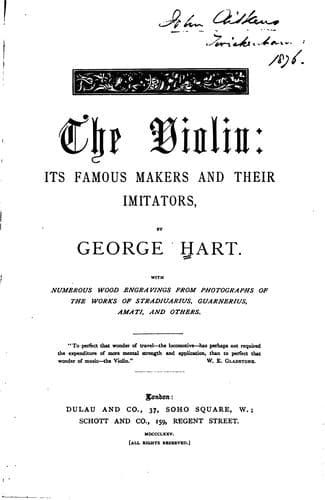
The Violin: Its Famous Makers and Their ImitatorsHart, George
History
The Violin: Its Famous Makers and Their Imitators
Hart, George
Violin -- History; Violin makers -- Biography
good fortune in having at last the opportunity of securing the real
thing at the price of "a mere song." The time of sale arrives. The
beauties of the instrument are dwelt upon by the auctioneer; he begs
to be permitted to say two hundred guineas to commence with. Silence
around. "Well, gentlemen, shall I say one hundred and fifty guineas?"
Dogged silence. "Come, come, gentlemen, this is mere trifling. A
'Joseph Guarnerius' for one hundred and fifty guineas! Shall I say one
hundred guineas?" The customary witty frequenter of sale-rooms, unable
to restrain himself longer, cries out, "I'll give yer a pound!" The
auctioneer sees the whole thing; it is a copy that he is selling, and
not the original. The pound bid is capped by another from our friend,
who fondly fancies himself behind the scenes. The subtle copyist,
seeing his eagerness, bids on his bid, and the "Joseph Guarnerius del
Gesu" falls with the hammer to the anxious buyer for ten pounds. He
demands possession of it at once, in case another may be substituted,
and retires, perfectly satisfied with his day's work. The wholesale
copyists are those who manufacture Violins in Bavaria and France in
large factories, where the Violins undergo all kinds of processes to
make them modern antiques. The wood is put into ovens and baked until
it assumes the required brownness, or steeped in strong acids until it
becomes more like a piece of charred wood than anything else; the
sharp edges are removed by the file; the wear of years is effected in
a few moments by rubbing down those parts subject to friction; it is
ticketed and dated, regardless alike of orthography and chronology,
the date being generally before or after the original's existence.
These imitations are so barefaced as to render them comparatively
harmless.
GUIDANTI, Giovanni, Bologna, about 1740. High model; sound-hole long;
purfling badly let in; the outer form inelegant, particularly the
middle bouts. At the Exhibition at Milan, 1881, a Viola d'Amore was
exhibited, signed "Joannes Guidantus, fecit Bononiae, anno 1715,"
ornamented with a beautiful head artistically carved, representing a
blindfolded Cupid.
GUILLAMI, Spanish family of Violin-makers, about 1680-1780.
HARTON, Michael, Padua, 1600. Lute-maker.
KERLINO, Joan, 1449. Maker of Viols. Numerous instruments of the
Violin shape have been attributed to this maker, particularly those of
quaint appearance, but it is doubtful whether he made any instruments
but those of the Viol type.
LAGETTO, Luigi, Paris, about 1753.
LANDOLFI, Carlo Ferdinando, Milan, 1750.
Carolus Ferdinandus Landulphus,
fecit Mediolani in Via S. Margaritae
anno 17--
Public-domain text, read in full here on John Shaqi.
Reviews
Reviews
No reviews yet
Be the first to share your thoughts on this work.
Elsewhere in the archive
Join the Discussion
Join the discussion
Sign in to leave a comment or review.
Sign InorCreate an account