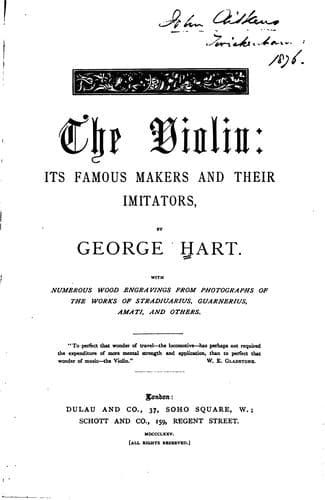
The Violin: Its Famous Makers and Their ImitatorsHart, George
History
The Violin: Its Famous Makers and Their Imitators
Hart, George
Violin -- History; Violin makers -- Biography
Though he belonged to the latest of the Italian makers, his merits
were of no ordinary kind. His instruments vary very much, and hence,
probably, a confusion has arisen as to there being two makers of this
name, which is not the case. Those instruments which have the bright
red varnish are certainly the best. The varnish is very transparent,
and, the wood being strikingly handsome, the effect is most pleasing.
The pattern is not a copy of Guarneri, as often stated, but thoroughly
original. His sound-hole cannot be considered an effective one, and is
not in keeping with the work. The outer edge is generally grooved. The
scroll is weak. His Violoncellos are mostly of small size. Some of
this maker's instruments are very unfinished, many not being purfled,
and having only a single coat of varnish.
LANZA, Antonio Maria, 1674. Copied the Brescian makers.
LAVAZZA, Santino, Milan, about 1700.
Santino Lavazza fece in Milano in Contrada larga 17--
LAVAZZA, Antonio, Milan.
Lavazza Antonio Maria fece in Milano in Contrada larga 17--
LINAROLLI, Venturo, Venice, 1520. A maker of Viols.
LOLY, Jacopo, Naples, 17th century. Of the Grancino type. Scroll
diminutive. Yellow varnish. Material very hard. Flat model. He made a
few large tenors.
MAGGINI, Giovanni Paolo, Brescia, 1590.
Gio Paolo Maggini in Brescia.
This famous maker followed Gasparo da Salo, and was his pupil. It is
surmised that he may have died of the plague in or about the year
1632. No Italian maker is more frequently mistaken than Maggini. Any
instrument having ornamentations on the back in the shape of purfled
scroll-work is at once said to be by Paolo Maggini. Barak Norman, the
old English maker, thus comes in for a large share of Maggini's
patronage, as also a vast number of early German makers, who adopted
similar devices; to the real connoisseur, however, there is no
difficulty in distinguishing the work. A more pardonable error is the
confusion of Gasparo da Salo and Maggini, which is of frequent
occurrence. The Double Basses of these two makers have much in common
to the eye of the not deeply versed examiner. Maggini, however, was
not so successful as his compeer in the selection of the _form_ of his
instruments. In them we miss the harmony of outline belonging to those
of Gasparo, particularly as relates to his Double Basses. Gasparo's
Violins are less harmonious in design, and evince his unsettled views
as to the form they should take; a perfectly natural circumstance when
the infantile state of the Violin in his day is considered. The
outline of Maggini is broad, but lacks the classic symmetry of the
rare old Brescian maker. The form is flat, and the means which he
adopted in order to obtain a full and telling tone were very complete.
The sides are frequently shallow, and in accordance with the outline.
With others who followed him, he evidently recognised the necessity of
reducing the height of the sides in proportion to the dimensions of
the instrument.
Public-domain text, read in full here on John Shaqi.
Reviews
Reviews
No reviews yet
Be the first to share your thoughts on this work.
Elsewhere in the archive
Join the Discussion
Join the discussion
Sign in to leave a comment or review.
Sign InorCreate an account