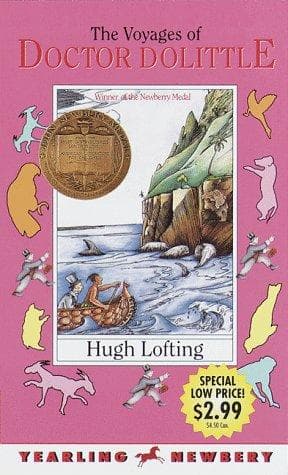
Animals -- Juvenile fiction; Fantasy literature; Human-animal communication -- Juvenile fiction; Voyages and travels -- Juvenile fiction
“Oh, I don’t know so much about that,” said the Doctor. “It is nice, I
admit, to be able to read and write. But naturalists are not all alike,
you know. For example: this young fellow Charles Darwin that people are
talking about so much now—he’s a Cambridge graduate—reads and writes
very well. And then Cuvier—he used to be a tutor. But listen, the
greatest naturalist of them all doesn’t even know how to write his own
name nor to read the _A B C_.”
“Who is he?” I asked.
“He is a mysterious person,” said the Doctor—“a very mysterious person.
His name is Long Arrow, the son of Golden Arrow. He is a Red Indian.”
“Have you ever seen him?” I asked.
“No,” said the Doctor, “I’ve never seen him. No white man has ever met
him. I fancy Mr. Darwin doesn’t even know that he exists. He lives
almost entirely with the animals and with the different tribes of
Indians—usually somewhere among the mountains of Peru. Never stays long
in one place. Goes from tribe to tribe, like a sort of Indian tramp.”
“How do you know so much about him?” I asked—“if you’ve never even seen
him?”
“The Purple Bird-of-Paradise,” said the Doctor—“she told me all about
him. She says he is a perfectly marvelous naturalist. I got her to take
a message to him for me last time she was here. I am expecting her back
any day now. I can hardly wait to see what answer she has brought from
him. It is already almost the last week of August. I do hope nothing
has happened to her on the way.”
“But why do the animals and birds come to you when they are sick?” I
said—“Why don’t they go to him, if he is so very wonderful?”
“It seems that my methods are more up to date,” said the Doctor. “But
from what the Purple Bird-of-Paradise tells me, Long Arrow’s knowledge
of natural history must be positively tremendous. His specialty is
botany—plants and all that sort of thing. But he knows a lot about
birds and animals too. He’s very good on bees and beetles—But now
tell me, Stubbins, are you quite sure that you really want to be a
naturalist?”
“Yes,” said I, “my mind is made up.”
“Well you know, it isn’t a very good profession for making money. Not
at all, it isn’t. Most of the good naturalists don’t make any money
whatever. All they do is _spend_ money, buying butterfly-nets and
cases for birds’ eggs and things. It is only now, after I have been a
naturalist for many years, that I am beginning to make a little money
from the books I write.”
“I don’t care about money,” I said. “I want to be a naturalist.
Won’t you please come and have dinner with my mother and father next
Thursday—I told them I was going to ask you—and then you can talk to
them about it. You see, there’s another thing: if I’m living with you,
and sort of belong to your house and business, I shall be able to come
with you next time you go on a voyage.”
“Oh, I see,” said he, smiling. “So you want to come on a voyage with
me, do you?—Ah hah!”
Public-domain text, read in full here on John Shaqi.
Reviews
Reviews
No reviews yet
Be the first to share your thoughts on this work.
Join the Discussion
Join the discussion
Sign in to leave a comment or review.
Sign InorCreate an account