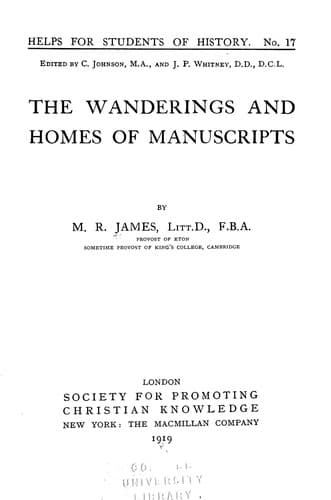
The Wanderings and Homes of ManuscriptsJames, M. R. (Montague Rhodes)
History
The Wanderings and Homes of Manuscripts
James, M. R. (Montague Rhodes)
Book collecting; Books -- History -- 400-1450; Books -- History -- To 400; Manuscripts
Before we pass to the next century a word must be devoted to a not
unimportant class of books which seem to have been manufactured chiefly
in Picardy and Artois, the illustrated Romances--_e.g._ the Grail and
Lancelot--of great bulk, usually in prose, which served to pass the
winter evenings of persons of quality. A few of these, and a book of
devotions to take to church (oftenest a Psalter at this time; later on a
book of Hours), were the staple books owned by the upper classes.
_Fourteenth Century._--If the thirteenth century gives us on the whole
the noblest books, the early part of the fourteenth affords the
loveliest. They come from England, France, and the Netherlands. A
noticeable element in their art is that of the grotesque and burlesque,
never, of course, quite absent even from early books, but now most
prominent and most delightful. The defect of the art of this time is
lack of strength and austerity; its delicacy is above praise.
The middle of the century sees Petrarch, and with him the Renaissance
begins. Italy has been producing great men in every field, but the work
of Petrarch reached farther and was more enduring than that of any
other.
France, tortured by wars, put forth little in the middle years, but then
came Charles V., a King who was really interested in books, and the
library he formed at the Louvre gave a stimulus to book-production which
spread wide and lasted long. Under Richard II. and through his Queen,
Anne of Bohemia, a foreign influence makes itself felt in England, and
some lovely results are achieved; but on the whole English art is
waning.
The Universities, and to some extent the monasteries, were throughout
this century great customers for the bulky books of scholastic divinity
(Duns Scotus, Albertus, and the like) and the later generation of
commentators on the Bible, such as Nicolas de Lyra and Hugo de S. Caro.
Many shelves are filled with these.
_Fifteenth Century._--The fifteenth century is our last; it ends the MS.
period. Under the influence of the Renaissance, now enormously potent,
every Italian noble forms a library. The scholars are seeking out the
ninth-century copies of the classics, and they discard the Gothic
(black-letter) hands of the thirteenth and fourteenth centuries in
favour of the Carolingian minuscule (or, some say that of the twelfth
century). As early as 1426 we find books written in a script adapted and
refined from this; we call it a Roman hand, though the great centre of
its propagation seems to have been Florence. In all essentials it is the
parent of the type in which this page will be printed.
Public-domain text, read in full here on John Shaqi.
Reviews
Reviews
No reviews yet
Be the first to share your thoughts on this work.
Join the Discussion
Join the discussion
Sign in to leave a comment or review.
Sign InorCreate an account