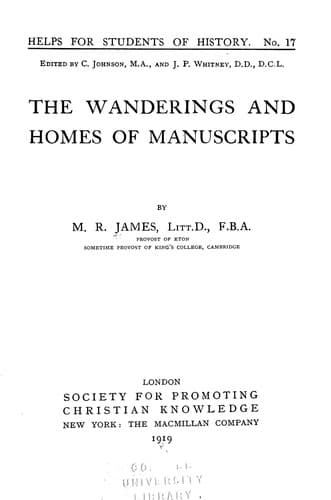
The Wanderings and Homes of Manuscripts — John Shaqi
The Wanderings and Homes of ManuscriptsJames, M. R. (Montague Rhodes)
History
The Wanderings and Homes of Manuscripts
James, M. R. (Montague Rhodes)
Book collecting; Books -- History -- 400-1450; Books -- History -- To 400; Manuscripts
Greek and Latin MSS. are the main subject. Oriental books we do not even
touch upon, and vernacular books in English or French have to take a
secondary place; and we may treat first of the Greek, for it is by far
the most compact division. In the case of both Greek and Latin books we
shall ask where and when they were chiefly made, when and how they left
their early homes, and where they are to be found now.
We shall rule out the whole of what may be called the classical
period--the libraries of Alexandria and Pergamon, the bookshops of
Martial's time--yes, and even the fourth-century library of Cæsarea--for
of these we have no relics. Our concern is with what exists to-day, or
what did exist until the nation, which has contributed so largely to
learning and history in the past, turned apostate, and to its lasting
shame destroyed and dispersed what more ignorant men had spared. The
mischief Germany has done--and it will be long before we learn the full
extent of it--she has done with open eyes.
We think primarily of Belgium and North-Eastern France as the scenes of
her worst devastations, but she has not confined her work of spoliation
to them. The Balkan provinces and Russia held great masses of Greek and
Slavonic MSS. as yet very incompletely known. The actual invasions of
German troops, and the wars and revolutions which Germany has fostered
in those regions, can hardly have been less mischievous than her
operations in the West.
GREEK MSS.: PRODUCTION AND DISPERSION
The area in which Greek MSS. were produced in the medieval period was
(with negligible exceptions) confined to Greece proper, "Turkey in
Europe," the Levant, and South Italy. In the monastic centres,
particularly Mount Athos, there were and are large stores of Greek
books, the vast majority of which are theological or liturgical; and the
theological authors most in vogue are those of the fourth and later
centuries. Copies of primitive Christian authors or classical ones are
comparative rarities. True, one or two of surpassing interest have been
found in such libraries; a famous Plato was brought by Dr. E. D. Clarke
from Patmos, and is at Oxford now; the treatise of Hippolytus against
heresies came in the forties from a monastery to the Paris library. But
these are exceptions. We have to look at Constantinople as by far the
most important centre of learning and of book-production. The city was
full of libraries, public and private, and of readers. The culture of
the place was, no doubt, self-contained; it did not aim at enriching the
outer world, which it despised; its literary productions were imitative,
the work of _dilettanti_ and decadents. Nevertheless, it preserved for
us wellnigh all that we now have of the best literature of Greece, and,
but for a few catastrophes, it would have handed on much more. Of
thirty-two historical writings read and excerpted by Photius in his
_Bibliotheca_, late in the ninth century, nineteen are lost; of several
Public-domain text, read in full here on John Shaqi.
Reviews
Reviews
No reviews yet
Be the first to share your thoughts on this work.
Join the Discussion
Join the discussion
Sign in to leave a comment or review.
Sign InorCreate an account