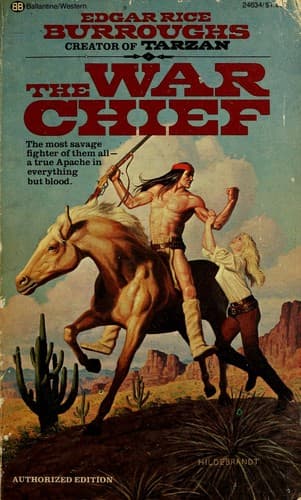
Apache Indians -- Fiction; Historical fiction; Western stories
In Sonora a savage chieftain had been raiding with a handful of his
fierce warriors. Now he was slinking northward bearing his loot on
stolen mules. It was Juh, chief of the Ned-ni; cruel, relentless Juh;
Juh the Butcher. He crossed the Sierra Madre and dropped down into
Chihuahua just above Janos. Mexican herders saw him and word was sent to
the officer in command of the troops camped by Casas Grandes. Thus did
Juh, unguessing, befriend Shoz-Dijiji, for the soldiers broke their camp
and rode away toward Janos, leaving the field clear for the Black Bear.
The soldiers did not catch Juh, for that wily old villain pushed on by
night and by day until the boundary lay south of him. Then he turned
west and entered Arizona and the domain of Na-chi-ta, son of
Cochise—the domain of the Cho-kon-en. Here, he had heard, Geronimo was
camped with his Be-don-ko-he. There was a very good reason that never
left the determined mind of Juh why he wanted to visit the Be-don-ko-he,
for he had not relinquished the hope that he might yet win Ish-kay-nay,
nor did he care by what means, being as little concerned by questions of
ethics as are most white men.
One day his party came upon a little pinto stallion feeding upon the
sparse vegetation in the bottom of a coulee, a pinto stallion that
looked up and nickered when he caught the familiar scent spoor of his
master’s people, and then came limping toward them.
Juh recognized Nejeunee and wondered. When the animal followed along
with them he made no effort to turn it back, and so he came to the camp
of Geronimo with the war pony of Shoz-Dijiji limping in the rear.
The finding of Nejeunee lame and at a distance from the camp of the
Be-don-ko-he had set Juh to thinking. It might mean any one of a number
of things but particularly it suggested the likelihood of Shoz-Dijiji’s
absence; for a good war pony is cherished by its owner, and it seemed
improbable that if Shoz-Dijiji was with the tribe that he would have
permitted his pony to remain thus at the mercy of the first band of
raiders, white or red, that might chance upon it. Unquestionably,
Shoz-Dijiji had ridden his pony from camp and something, equally
unquestionable, had happened to the pony. Perhaps at the same time
something had happened to Shoz-Dijiji.
Juh sought the father of Ish-kay-nay and renewed his importuning of the
old warrior for the hand of his daughter, nor did he mention
Shoz-Dijiji, but he learned all that he wished to know—that Ish-kay-nay
had accepted the advances of his rival and that the latter had gone to
find the fifty ponies that the old man had demanded.
“He promised Ish-kay-nay that he would return with the full moon,” said
the old man, “but the time is almost gone and nothing has been heard of
him. Perhaps he will not return.”
Public-domain text, read in full here on John Shaqi.
Reviews
Reviews
No reviews yet
Be the first to share your thoughts on this work.
Elsewhere in the archive
Join the Discussion
Join the discussion
Sign in to leave a comment or review.
Sign InorCreate an account