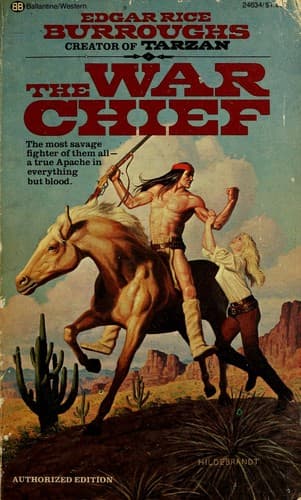
Apache Indians -- Fiction; Historical fiction; Western stories
Cunning, unscrupulous, Juh seized upon his opportunity. “He will not
return,” he said. “Shoz-Dijiji is dead.” The old man looked pleased. “In
Sonora he was killed by the Mexicans. There we were told that a young
warrior had been killed while attempting to drive off a bunch of horses.
We did not know who he was until we found his pony. It was lame. We
brought it with us. Talk with the girl. If she will feed and water my
pony, come to me. Juh will give the father of Ish-kay-nay fifteen
ponies.”
“The other was to have given me fifty,” said the old man.
Juh laughed. “That was talk,” he said. “How could he give you fifty
ponies when he had but three? I have fifteen ponies; that is better than
fifty that do not exist.”
“You have more than fifteen ponies,” the old man reminded him.
“Yes, I have many more, and I am a great chief. Juh can do many things
for the father of Ish-kay-nay.”
“Twenty-five ponies,” suggested the other, preferring twenty-five ponies
to the chance that Juh would forget the less concrete suggestion of
future obligation.
“Fifteen ponies and five mules,” said Juh.
“Twenty-five ponies. The girl is a good daughter. My heart will be heavy
with sorrow when she is gone.”
“Twenty ponies and five mules,” snapped Juh with finality, turning upon
his heel.
“And a rifle,” added the father of Ish-kay-nay.
“And a rifle,” acquiesced the chief of the Ned-ni.
“And ammunition,” exclaimed the old man, hurriedly; but the deal was
made on the basis of twenty ponies, five mules and a rifle.
Ish-kay-nay, sitting beneath the shade of a tree, was sewing pretty
beads upon a bit of buckskin, using an awl and deer sinew. She hummed
contentedly to herself as she planned for the future—the long, happy
future with Shoz-Dijiji. She would make many pretty things for them both
and for their tepee. Later she would make other pretty things, tiny
things, for future war chiefs. Her father found her thus.
“Shoz-Dijiji will not return,” he said.
She looked up at him quickly, sensing a new note in a statement that she
had already heard many times since her lover had departed. Heretofore
the statement had implied only hope, now it was redolent of sweet
relief.
“Why?” she asked.
“He is dead.”
The heart of Ish-kay-nay went cold and numb within her, but the
expression upon her face underwent no change. “Who says so?” she
demanded.
“Juh.”
“Either Juh lies, or he has himself slain Shoz-Dijiji,” said the girl.
“Juh does not lie, nor has he slain Shoz-Dijiji.” Then he told her all
that Juh had told him. “I am an old man,” he continued. “I have not long
to live. Before I die I would see my daughter, whom I love, safe with a
great warrior. Juh is a great warrior. He will treat you well. He has
many women and you will not have to work hard. If he ties his pony
before our tepee Ish-kay-nay will lead it to water and feed it?”
“I do not believe that Shoz-Dijiji is dead,” she said.
“If you did, would you go to Juh?”
Public-domain text, read in full here on John Shaqi.
Reviews
Reviews
No reviews yet
Be the first to share your thoughts on this work.
Elsewhere in the archive
Join the Discussion
Join the discussion
Sign in to leave a comment or review.
Sign InorCreate an account