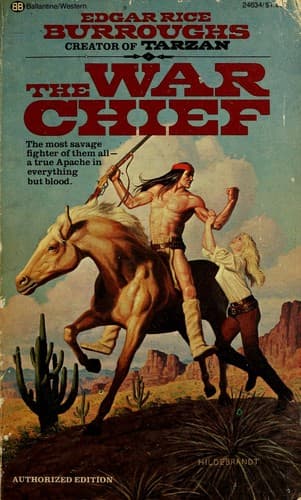
Apache Indians -- Fiction; Historical fiction; Western stories
Far ahead, miles and miles away, lay water upon the trail that
Shoz-Dijiji had thus purposely selected, and somehow the horses knew
that it was there as horses seem always to know. No longer did the
Apache have difficulty in keeping the great herd upon the right trail,
in preventing it from turning back. On the contrary his own mount,
having carried him half a day, found difficulty in keeping pace with its
fellows.
How he took them, alone and unaided, across those weary, dusty, burning
miles, through scorching deserts and rugged mountains equally scorching,
along a trail beset by enemies, pursued by wrathful vaqueros, would well
have been the subject of a deathless epic had Shoz-Dijiji lived in the
days of Homer.
Rests found him always where there were water and grass, sometimes at
the end of a long day, or again at the close of a long night; for
Shoz-Dijiji, more tireless than the horses, could travel twenty hours on
end, and more if necessary. He caught fleeting moments of sleep while
the horses watered and fed, always lying on the trail behind them that
they must disturb him if they turned back; and turn back they did on
more than a single occasion, causing the Apache many an hour of hard and
perilous riding; but he was determined to bring them through without the
loss of a single horse if that was humanly possible of accomplishment.
He would give the father of Ish-kay-nay fifty horses and he would still
have fifty for himself, and fifty such horses as these would make
Shoz-Dijiji a rich man.
He thought all of the time about Ish-kay-nay. How proud she would be!
For Shoz-Dijiji appreciated well and fully the impressiveness of his
exploit. If he had been acclaimed as a great warrior before, this would
go far toward establishing him as one of the greatest. Forevermore
mothers would tell their children of the bravery and prowess of
Shoz-Dijiji, nor was he either mistaken or overvain. Shoz-Dijiji had
indeed performed a feat worthy of the greatest heroes of his race.
Already he had crossed the boundary and was safe in the country of the
Cho-kon-en, and all that last night he urged the tired horses on that he
might reach camp in the morning. His arms and his heart ached for
Ish-kay-nay—little Ish-kay-nay, the playfellow of his childhood, the
sweetheart of today, the mate of the morrow.
Toward dawn he came to water and let the herd drink. He would rest it
there for an hour and then push on, reaching camp before the excessive
heat of this early September day had become oppressive. Quenching his
own thirst and that of the horse he rode, Shoz-Dijiji lay down to sleep,
his crude bridle rein tied to his wrist.
The horses, tired and footsore, were quiet. Some of them browsed a
little upon the dried, yellow grasses; many lay down to rest. The sun
rose and looked down upon the little mountain meadow, upon the drowsing
horses and the sleeping man.
Public-domain text, read in full here on John Shaqi.
Reviews
Reviews
No reviews yet
Be the first to share your thoughts on this work.
Elsewhere in the archive
Join the Discussion
Join the discussion
Sign in to leave a comment or review.
Sign InorCreate an account