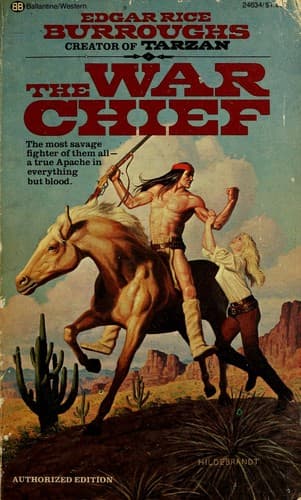
Apache Indians -- Fiction; Historical fiction; Western stories
Another looked down, also—a tall, gaunt man with cheeks like parchment
and a mustache that had once been red, but was now, from over exposure
to the Arizona sun, a sickly straw color. He had a reddish beard that
was not yet old enough to have bleached. Upon the blue sleeves of his
jacket were yellow chevrons. Sergeant Olson of “D” Troop looked down and
saw exactly what the sun saw—an Apache buck, habited for the war trail,
asleep beside a bunch of stolen stock. Sergeant Olson needed but a
glance to assure his experienced cavalry eye that these were no Indian
cayuses.
He withdrew below the edge of the hill from which he had been
reconnoitering and transmitted a gesture of silence toward other men
dressed in blue who sat their horses below him, and beckoned to an
officer who quickly rode upward and dismounted. Presently the officer
shared the secret with Sergeant Olson and the sun. He issued whispered
orders and forty men rode down a narrow ravine and crossed a ridge into
the canyon below Shoz-Dijiji.
The sun, crossing the withers of Shoz-Dijiji’s horse, shone upon the
warrior’s face and he awoke. He arose and mounted his horse. Sergeant
Olson, looking down from above, watched him. If he went down the canyon,
all right; if he went up, all wrong—there were no soldiers up the
canyon. Shoz-Dijiji circled the herd and started it up the canyon. This
did not suit Sergeant Olson; anyhow, the only good Indian is a dead
Indian. The noncommissioned officer drew his army Colt from its holster,
took accurate aim and fired. Who could blame him?
Two days before his bunkie had been shot down in cold blood at Cibicu
Creek by an Apache scout who was in the service and the uniform of the
United States. He had seen Captain Hentig murdered, shot in the back, by
another scout named Mosby; he had seen Bird and Sondergros and Sullivan,
and others killed; and, he smiled even then at the recollection, he had
seen Ahrens, a “D” Troop bugler, put three bullets into the head of that
old devil, Nakay-do-klunni. Sergeant Olson called him Bobbydoklinny.
Tough old buzzard, he was! Those three forty-fives in his cabezas hadn’t
killed him, and Smith, another “D” Troop sergeant, had found him
crawling about on the ground after dark and had finished him with an
axe—good old Smith!
Shooting down at a considerable angle from a considerable distance above
one’s target is difficult. No, shooting down is not difficult, but
hitting your target is. Sergeant Olson missed. With an oath he stood up
and commenced firing rapidly and Shoz-Dijiji, seeing him immediately,
returned the fire. Sergeant Olson emitted an explosive oath and dived
forward upon the brow of the hill. There he lay, very quiet, while
Shoz-Dijiji urged his horse up the steep canyon side opposite. It is the
Apache’s first instinct when surprised to seek some rugged, inaccessible
spot from which he can survey without being surveyed, and always a place
difficult or impossible for horses.
Public-domain text, read in full here on John Shaqi.
Reviews
Reviews
No reviews yet
Be the first to share your thoughts on this work.
Elsewhere in the archive
Join the Discussion
Join the discussion
Sign in to leave a comment or review.
Sign InorCreate an account