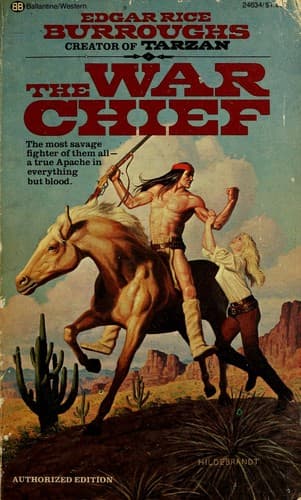
Apache Indians -- Fiction; Historical fiction; Western stories
From behind a knoll near the mouth of the canyon the Black Bear saw the
soldiers of “D” Troop drive the horses out upon the plain and toward the
north. As he knew all the vast domain of his people Shoz-Dijiji knew
this plain, knew it as he knew the wrinkles in the face of
Sons-ee-ah-ray, knew the route the soldiers would take across it, knew
the windings of the dry wash that cut deeply through it from the
canyon’s mouth. He waited where he was until a rise of ground hid him
from the troopers entering the plain below.
Cautiously the Apache rode down into the wash and along its dry, sandy
bottom where the steep, high banks hid him from the sight of the
soldiers. Where the wash took a broad sweep to the east he urged his
mount to a run. The sand beneath its feet gave forth no dust nor any
sound.
The soldiers, moving in a more direct line, were drawing away from him
as Shoz-Dijiji raced, a silent shadow, toward the destination he had
chosen. The wash turned toward the north and then again in a westerly
direction, making a wide curve and coming again very close to the trail
along which the soldiers were driving Shoz-Dijiji’s herd. Toward this
point the Apache was racing, in his mind a bold plan, such a plan as
only an Apache mind might conceive—of all warriors the most cautious,
also, of all warriors, the most fearless when emergency demanded
fearlessness.
Other warriors might pit themselves gallantly and gloriously against
great odds in defense of the weak, in furtherance of some lofty ideal or
for the honor of a flag; but it remained for an Apache, armed with a
six-shooter, a knife, a bow and some arrows, to seriously conceive the
idea that he might successfully attack ten fully armed cavalrymen for
the sake of some captured loot! But perhaps we are unfair to
Shoz-Dijiji, for was there not also Ish-kay-nay?
Where the trail came again close to the wash there was a way up its
steep side to the plain above, a way that Shoz-Dijiji knew. It had been
made by range stock crossing at this point. When the last of the
soldiers had passed it they were startled by a loud Apache whoop and the
bark of a six-shooter. Yelling, firing, Shoz-Dijiji charged straight
toward the rear of the herd, straight toward the ten mounted troopers.
The horses broke into a gallop, frightened by the yells and the shots.
The soldiers, sure that there must be other hostiles hiding in the wash,
fired at Shoz-Dijiji and then turned their attention toward the point
where they expected the main force of the enemy to develop, toward the
wash. Shoz-Dijiji, still yelling, drew away behind the racing herd.
But only for a moment were the troopers disconcerted by the suddenness,
by the sheer effrontery of the attack. A sergeant raised his carbine to
his shoulder, his mount, well-trained, stood motionless as its rider
slowly dropped the sights upon the bright bay gelding, already a long
shot for a sharpshooter, even at a fixed target.
Public-domain text, read in full here on John Shaqi.
Reviews
Reviews
No reviews yet
Be the first to share your thoughts on this work.
Elsewhere in the archive
Join the Discussion
Join the discussion
Sign in to leave a comment or review.
Sign InorCreate an account