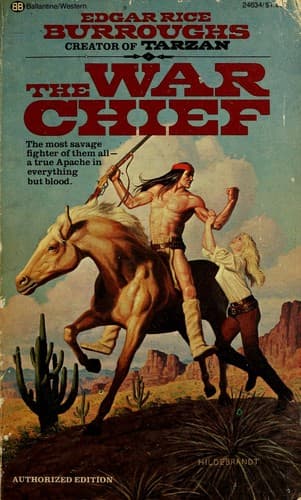
Apache Indians -- Fiction; Historical fiction; Western stories
From the top of the hogback Shoz-Dijiji looked over at Sergeant Olson,
who had not moved. He saw no other soldiers there, but he knew where
there was one soldier there were others, usually many of them. He cocked
his ears. Ah, what was that? From down the canyon came unmistakable
evidence of the clumsy approach of clumsy white-eyes. They made enough
noise, thought Shoz-Dijiji, to have been a great army, but he knew that
they were not. All the members of the six tribes including their women
and children could have passed along this same trail with a tenth the
commotion—only the soft swish of their moccasined feet.
Shoz-Dijiji hid his horse on the far side of the hogback and crept back
to watch. He saw the soldiers come, and hate and disappointment surged
through him in hot, savage waves as he watched them round up his hundred
horses and drive them back down the canyon, while a detachment from the
troop followed upward in search of Indians.
Others went up the opposite side of the canyon to look for Olson; and as
they found him Shoz-Dijiji mounted his horse below the edge of the
hogback and rode down toward the valley, paralleling the course taken by
the soldiers and his horses, loath to give them up, hoping against hope
that some circumstance might give him the opportunity to win them back,
ready to risk his life, if need be, for the price of Ish-kay-nay and
happiness.
Bitter were the thoughts of Shoz-Dijiji as he followed the troopers who
had stolen his herd, for by the hoary standards of the Apache, ages old,
it _was_ theft and the herd was his. Had he not taken it by virtue of
courage and cunning, winning it fairly? Had the soldiers been taking his
herd for themselves there would have been less anger in the heart of
Shoz-Dijiji, for he could accord to others the same rights that he
demanded for himself, but they were not.
Experience had taught him that the fool white-eyes took stock from the
Indians and tried to return it to those from whom the Indians had taken
it, profiting in no way. Therefore he believed that they did so purely
for the purpose of persecuting the Indians, just as they had taken their
water and their lands and ruined their hunting grounds, which was, in
the sight of Usen and his children, but a part of the plan of the pindah
lickoyee to exterminate the Shis-Inday.
Did not all men know that the thing the pindah lickoyee called
government had hired many hunters to exterminate the buffalo and all
other game, thus forcing the Indians to remain on the reservations and
beg for rations or starve? Bitter were the thoughts of Shoz-Dijiji as he
followed the troopers down toward the plain.
Public-domain text, read in full here on John Shaqi.
Reviews
Reviews
No reviews yet
Be the first to share your thoughts on this work.
Elsewhere in the archive
Join the Discussion
Join the discussion
Sign in to leave a comment or review.
Sign InorCreate an account