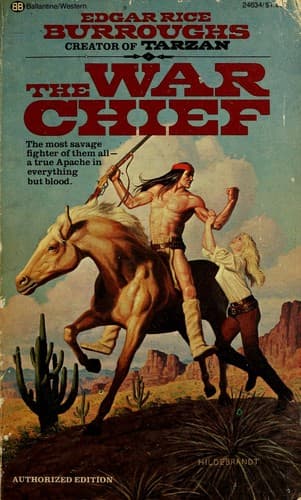
Apache Indians -- Fiction; Historical fiction; Western stories
Dismounting, the Indian led his pony cautiously forward toward the crest
of the ridge; ready in his right hand was his six-shooter, alert his
ears, his eyes, his every sense. Beyond that summit he knew there was a
precipitous hillside, dropping to the bottom of a canyon. A man on foot
might scale it, but it was no place to remain and fight, for there was
little footing and no cover. These things his knowledge of the spot told
him, assuring him that it would be safe to approach the edge of the
declivity and reconnoiter, as the white-eyed one must by this time be at
the bottom of the canyon.
Cautiously Shoz-Dijiji peered over the edge, several yards from the spot
at which the man had disappeared, knowing as he did that if the latter
was waiting to fire at him that his attention would be directed upon the
spot from which he had discovered the Indian and not even a few yards to
the right or to the left; but there was no one waiting to fire at
Shoz-Dijiji. At the foot of the canyon wall lay a young white man—quite
motionless he lay in a crumpled heap. A few yards away, tied to a
stunted bush, was a saddled pony.
Shoz-Dijiji remounted and riding a hundred yards up the rim of the
canyon zigzagged down its steep side. The man still lay where he had
fallen as Shoz-Dijiji approached him and reined in his pony. The Apache
dismounted and stooped to examine the white, first removing the other’s
revolver from its holster. The man was young, twenty perhaps. He was not
dead, as the Indian had at first thought likely, for the canyon wall was
high and steep and there were rocks at its base, and it appeared evident
that the man had fallen the full distance.
Shoz-Dijiji stood looking at his helpless enemy. His eyes appraised his
find in terms of loot; there was a good Colt and many rounds of
ammunition, and he had seen a rifle resting in its boot along the side
of the tethered pony. Many were the other possessions of the white-eyed
one that aroused the cupidity of the swart savage. Shoz-Dijiji fingered
the hilt of his hunting knife, a keen butcher knife made in Connecticut
for no more sanguinary service than slicing roasts in some quiet New
England kitchen. How easy it would be to slit the throat of the hated
pindah lickoyee and appropriate his belongings.
It was while Shoz-Dijiji was thinking these thoughts that the young man
opened his eyes and looked up into the stern, painted face of the red
man. Instinctively the youth reached for his Colt, realized that it was
gone, recognized it then in the hands of the Indian, and closed his eyes
in despair. He felt sick and he knew that he was badly injured by the
fall, how badly he could only guess.
Public-domain text, read in full here on John Shaqi.
Reviews
Reviews
No reviews yet
Be the first to share your thoughts on this work.
Elsewhere in the archive
Join the Discussion
Join the discussion
Sign in to leave a comment or review.
Sign InorCreate an account