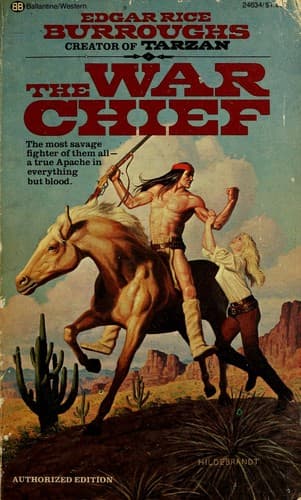
Apache Indians -- Fiction; Historical fiction; Western stories
He had been without water for two days, he was hopelessly lost, and now
that the end had come he was not sure but that after all it was
something of a relief. That which caused him the greatest apprehension
was his knowledge of the possible manner of his death at the hands of
one of these human fiends. His very soul shuddered and shrank from the
torture that he knew might be in store for him.
Shoz-Dijiji looking down at him recalled his promise to the white girl.
He turned to continue his journey, knowing that death must surely
overtake the white, and then he stopped. The young man, hearing him move
away, had opened his eyes again. He saw the Apache rein in his pony,
hesitate, and then wheel back toward him. Again he dismounted at his
side, stooped down and felt of his legs—lifting them, flexing them.
He put an arm beneath the youth’s shoulders and lifted him to his feet.
To the great surprise of the white man he found that he could stand,
that his body was not broken in any place. The Indian helped him to walk
to his pony and lifted him into the saddle. Then he offered him his
canteen, for he had seen that the youth’s was empty and, too, he had
seen in his drawn face, in his swollen lips, the signs of thirst. The
boy seized the canteen greedily and placed it to his lips. Shoz-Dijiji
permitted him a brief swallow and then took the water from him. Now all
fear had left the white man.
“You friendly Indian, eh John?” he asked.
“Me Chihuicahui!” said Shoz-Dijiji fiercely, proudly, tapping his great
chest, knowing that the whites knew the fighting, warlike tribes by that
name.
“Holy Moses!” breathed the youth. “You a Cheeracow?”
“You lost?” demanded the Black Bear.
“I shore am,” replied the other.
“Come!” commanded the Apache. He urged his pony up the canyon and the
steep zigzag trail to the summit. When the white had reached his side
the Indian asked, “You savvy Billings ranch?”
“Yes,” replied the youth.
Shoz-Dijiji pointed eastward and a little north to where a dim, blue
butte was barely visible behind its veil of haze. “Billings ranch
there,” he said. “Mebbyso one march.” He took the other’s empty canteen
and poured the remaining water from his own into it. He emptied the
cartridges from the chambers of the white’s revolver and rifle into his
palm and handed the empty weapons back to their owner; then he wheeled
his pony and cantered away. Shoz-Dijiji was taking no chances on the
honor of a white man—he knew them too well.
For a long time the young man sat looking after his benefactor, his face
reflecting the bewilderment that filled his thoughts.
“Well, ding bust my ornery hide!” he remarked, presently, and turned his
horse toward the dim, blue butte beyond the horizon.
So, did Shoz-Dijiji the Be-don-ko-he fulfill his promise to the white
girl who had befriended him.
Public-domain text, read in full here on John Shaqi.
Reviews
Reviews
No reviews yet
Be the first to share your thoughts on this work.
Elsewhere in the archive
Join the Discussion
Join the discussion
Sign in to leave a comment or review.
Sign InorCreate an account