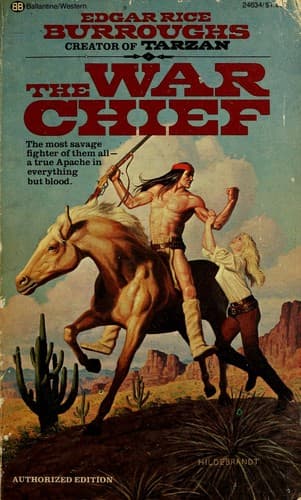
Apache Indians -- Fiction; Historical fiction; Western stories
Late that afternoon he lay up for a few hours at a place where there was
water and shortly after dark, when he had resumed his way, he came upon
the first signs of the southward-bound renegades—a broad, well-marked
trail, and over it the spoor of cavalry, pressing close behind. In a few
miles, by a rocky hill, he found evidences of an engagement and in the
moonlight he read the story writ clear upon the ground, in the dust,
among the boulders, of the Apache rear guard that had waited here and
stopped the advancing soldiers until the main body of the Indians had
moved to safety among the rough hills. He guessed that his people had
passed through those hills the previous afternoon and that now, under
cover of darkness, they were crossing the valley upon the opposite side
with the soldiers of the white-eyes in close pursuit.
Farther on again he came upon a place where the Apaches had commenced to
break up into small parties and scatter, but there was the older trail
of the herd that moved steadily on toward the border. Shoz-Dijiji judged
that it was two days ahead of the main body, doubtless being pushed on
toward safety by hard riding youths and that it would win the border
long before the troops.
During the night he heard shots far, far ahead; the soldiers had caught
up with one of the scattering bands, or perhaps the Apaches had prepared
an ambush for them. The firing lasted for a long time, grew dimmer and
then ceased—a running fight, mused Shoz-Dijiji, restless that he was
not there. Night fighting was rare; the soldiers must be pressing his
people closely.
It was a hard night for Shoz-Dijiji, urging on his tired mount,
constantly on the alert for the enemy, chafing under the consequent
delay; but at last the day dawned as he emerged upon the southern slope
of the mountain range and overlooked the broad valley across which his
people should have passed during the night. Far away, near the base of
the opposite mountains he saw several columns of dust, but whether they
were caused by Apaches or soldiers he could not be sure, though it was
doubtless the latter, since the Indians had broken up into small bands
that would make little dust.
A few minutes later he came upon the scene of last night’s battle. It
was marked by the bodies of three cavalry horses, empty cartridge
shells, some military accoutrement, an Apache head-bandanna. As he rode
across the spot where the engagement had been fiercest his eyes took in
every detail of the field and he was sure that there had been no ambush
here, but that his people had been overtaken or surprised. It was not
such a place as an Apache war chief would choose to make a stand against
an enemy.
He was moving on again when something arrested his attention. Always
suspicious, instantly on the defensive, he wheeled about to face the
direction from which there had come to his ears the faintest of sounds.
What was it that had broken the silence of this deserted field of death?
Public-domain text, read in full here on John Shaqi.
Reviews
Reviews
No reviews yet
Be the first to share your thoughts on this work.
Elsewhere in the archive
Join the Discussion
Join the discussion
Sign in to leave a comment or review.
Sign InorCreate an account