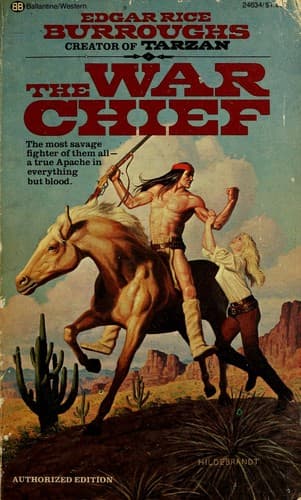
Apache Indians -- Fiction; Historical fiction; Western stories
“No, but I see you. Apache see everything—know everything. You see
white girl again you tell her Shoz-Dijiji no can return her pony. Him
dead.”
“Who, Shoz-Dijiji?”
“No, pony. I am Shoz-Dijiji,” and he tapped his chest proudly. “Pony
dead.”
“Oh.”
“You tell her by and by. Shoz-Dijiji no can send her pony back; he send
back her white-eyed lover instead. You savvy?”
“Why, I’m not her—well, I _will_ be damned!”
“Now I go. You move—Shoz-Dijiji shoot. This time he kill. You savvy?”
“Yes, go ahead; and you needn’t think I’ll try to get you after what
you’ve done for me,” and he glanced at the dead Ned-ni beside them.
“But, say, before you go won’t you tell me how and where and when you
got a pony from Wichita Billings?”
“Me no savvy,” stated Shoz-Dijiji, and turning, he leaped swiftly down
the hillside to disappear a moment later from the sight of the
astonished subaltern.
As Shoz-Dijiji had vanished among the hills so had the other warriors,
and as the commanding officer reassembled his troop a crestfallen second
lieutenant walked down a hillside and approached his captain. The “old
man” was furious at himself because he had ridden directly into an
ambush, because he had lost some good men and several horses, but
principally because the hostiles had slipped through his fingers with
the loss of only two of their number. And so he vented his spleen upon
the unfortunate King, who had never guessed until that moment how much
contempt, sarcasm and insult could be crowded into that single word
_MISTER_.
He was relieved of duty and ordered into arrest, released and returned
to duty, three times in the ensuing fifteen minutes after he rejoined
the troop. His spirit was raw and sore, and he conceived for his
superior a hatred that he knew would survive this life and several lives
to come; but that was because he had been but a few weeks under the “old
man.” Before that campaign was over Lieutenant King would have ridden
jubilantly into the mouth of Hell for him. But just then he did not know
that his captain’s flow of vitriolic invective and censure but masked
the fear the older man had felt when he saw the youth’s utter disregard
of danger leading him straight into the jaws of death.
The old captain knew a brave man when he saw one and he knew, too, that
the steadying influence of experience in active service would make a
great Indian fighter of such as his second had proven himself to be, and
in the depth of his heart he was very proud of the boy, though he would
have rather his tongue had been cut out than to admit it in words. It
was his way to win loyalty by deeds, with the result that his men cursed
him—and worshipped him.
Public-domain text, read in full here on John Shaqi.
Reviews
Reviews
No reviews yet
Be the first to share your thoughts on this work.
Elsewhere in the archive
Join the Discussion
Join the discussion
Sign in to leave a comment or review.
Sign InorCreate an account