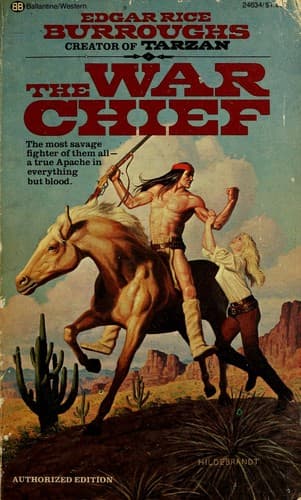
Apache Indians -- Fiction; Historical fiction; Western stories
In the light of what Lieutenant King had heard of the character and
customs of Apaches he found it difficult to satisfactorily explain the
magnanimity of the very first one it had been his fortune to encounter.
He found his preconceived estimate of Apache character hanging in
mid-air with all its props kicked from under it, and all he could do was
wonder.
Shoz-Dijiji was wondering, too. He knew that he had not acted upon
impulse and perhaps that was why his action troubled him in retrospect.
He tried to be sorry that he had not slain the hated pindah lickoyee,
yet, when he thought of the happiness of the white girl when she learned
that her lover had been spared, he was glad that he had not killed him.
Too fresh was the wound of his own great grief to permit him to be
callous to the possible grief of another in like circumstance, and in
this case that other was a friend who had been kind to him. Yes,
Shoz-Dijiji was satisfied that he had done right. He would have no
regrets. As for the Ned-ni—well, he had earned death by his insult.
Following the fight with “B” Troop the little band of Ned-ni broke up
once again into still smaller parties and scattered by ones and twos, so
that there remained nothing in the way of a trail for the soldiers to
follow. Shoz-Dijiji moved directly south into the Sierra Madre,
searching for Juh. To every familiar haunt of the Apache went the
silent, terrible figure, searching, ever searching; his sorrowing heart
like lead in his bronze breast, his soul a torment of consuming fires of
hate.
From many a commanding peak he scanned the country north and south, east
and west, through the field glasses he had taken from the young officer,
and then one day he came upon the spoor of an Apache in the soft earth
beside a bubbling spring. You or I might not have been able to discern
that a man had stepped there, but Shoz-Dijiji saw the dim print of an
Apache war moccasin. He plucked some of the down-pressed grass and
breaking it knew from the condition of the juices within that a man had
stood there on the preceding day, and then he sought and quickly found
the direction of the other’s trail, leading toward the south.
Not again, no matter where it went, did Shoz-Dijiji lose sight of the
spoor of him whom he followed. Early the next morning he left it
momentarily while he ascended a peak and scanned the mountains to the
south. Ah, at last! In the distance, tenuous, vapory blue, almost
invisible rose a tiny waft of smoke. Indians! Apaches, doubtless.
Ned-ni, perhaps. Juh! Be good, O Usen! Let it be Juh!
It was noon when Shoz-Dijiji passed silently and unseen the sentries of
the Ned-ni and stalked majestically into the camp. His quick eyes took
in every detail of the scene. He saw two of Juh’s squaws and several of
his children, but Juh he did not see. But Juh must be near. His long
search was ended.
Public-domain text, read in full here on John Shaqi.
Reviews
Reviews
No reviews yet
Be the first to share your thoughts on this work.
Elsewhere in the archive
Join the Discussion
Join the discussion
Sign in to leave a comment or review.
Sign InorCreate an account