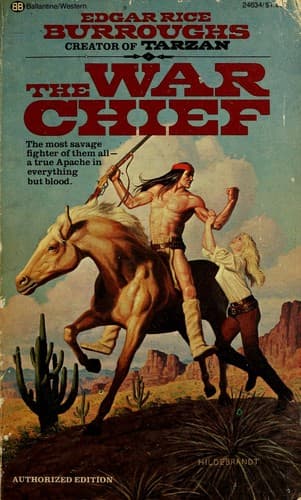
Apache Indians -- Fiction; Historical fiction; Western stories
Warriors gathered about him, asking many questions; surprised to see him
in the flesh, whom they had thought dead. He told them of the fight with
the white soldiers, of the scattering of the balance of the hostiles;
that the troops might be following them down into Mexico. He did not ask
for Juh; that was not his way. He waited. Perhaps Juh would come soon,
but he was impatient. A terrible thought smote him.
“Were many of the Ned-ni killed when you fought the white-eyes?” he
asked.
“No,” they told him, “two warriors, whose bodies we brought along and
buried, and a squaw was missing.” They did not mention her name. Seldom
do the Apaches call their dead by name. But there was no
need—Shoz-Dijiji knew that they spoke of Ish-kay-nay.
“Was she killed by the soldiers?” asked Shoz-Dijiji.
“We do not know. Juh would not return to find out.”
“Juh—he is not here,” remarked Shoz-Dijiji, casually. That was as near
as he would come to asking where Juh was.
“He is hunting in the mountains,” said a warrior, waving an informatory
hand in the direction of a rugged ridge above the camp.
Shoz-Dijiji walked away. He could not wait. He went from shelter to
shelter, talking, but only to throw off suspicion, for he knew that some
of them must guess why he was here. When he could, he slipped away among
the trees and moved rapidly up the shoulder of the ridge, diagonally
that he might cross the spoor of the man he sought, nor had he long to
go before he picked up the imprint of a great moccasin, such a moccasin
as Juh might wear.
A human tiger, then, he tracked his prey. Up rugged mountainsides ran
the trail, across rocky hogbacks where none but an Apache eye might
trace it, down into dank ravines and up again along the bold shoulder of
a mighty peak. It was there that Shoz-Dijiji heard something moving just
beyond the curve of the mountain ahead of him.
He stopped and listened. The thing was approaching, already he had
interpreted it, the sound of moccasined feet moving through low brush.
Shoz-Dijiji waited. Two seconds, three, five. The figure of a man loomed
suddenly before him. It was Juh. The end of the hate-trail had been
reached. Juh was returning to camp.
The chief saw and recognized Shoz-Dijiji instantly. He was armed with
bow and arrows and a knife. Shoz-Dijiji carried these and a revolver in
addition. The carbine he had cached before he entered the Ned-ni camp.
“What does the Be-don-ko-he here?” demanded Juh.
“I, Shoz-Dijiji, have come to kill a great liar. I have come to kill a
great coward who cannot protect his women. I have come to kill Juh.”
“You cannot kill Juh,” said the older man. “Strong is the medicine of
Juh. The bullets of the white-eyes cannot enter the body of Juh—they
will bounce back and kill you. Nakay-do-klunni made this medicine
himself. Go away, before it kills you.”
“Nakay-do-klunni is dead,” replied Shoz-Dijiji. “His medicine is no
good.”
“What he made for Juh is good.”
Public-domain text, read in full here on John Shaqi.
Reviews
Reviews
No reviews yet
Be the first to share your thoughts on this work.
Elsewhere in the archive
Join the Discussion
Join the discussion
Sign in to leave a comment or review.
Sign InorCreate an account