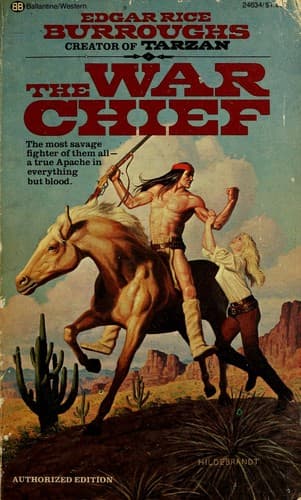
Apache Indians -- Fiction; Historical fiction; Western stories
The muscles of Juh’s cruel face gave no hint of the rage and malice
surging through his savage breast, but Shoz-Dijiji, the Black Bear, was
not deceived. He well knew the relentless hatred that the war chief had
conceived for him since the day that Go-yat-thlay had thwarted Juh’s
attempt to dash out his infant brains against the tire of his murdered
father’s wagon, even though the lad knew nothing of the details of that
first encounter and had often wondered why Juh should hate him.
As a matter of fact Juh’s hatred of the boy was more or less impersonal,
in so far as Shoz-Dijiji was concerned, being rather a roundabout
resentment against Go-yat-thlay, whom he feared and of whose fame and
prestige he was jealous; for Go-yat-thlay, who was one day to become
world famous by his Mexican-given name, Geronimo, had long been a power
in the war councils of the Apaches; further, too, the youngest and
prettiest of his squaws had also been the desired of Juh. It was she who
had the care of Shoz-Dijiji; it was she, Morning Star, who lavished love
upon the boy. To strike at the woman who had spurned him and the man who
had inflamed his envy and jealousy, Juh bided his time until he might,
with impunity, wreak his passion upon the lad.
Now no one had time for thoughts of anger or revenge, for tonight was to
be a great night in the camp of Cochise the war chief. For two days the
bucks had eaten little or nothing in preparation for the great event;
the women had brewed the tizwin; the drums were ready.
Night fell. Before the entrance to his hogan stood Go-yat-thlay with his
women and his children. From a beaded buckskin bag he took a pinch of
hoddentin and cast it toward the moon.
“Gun-ju-le, chil-jilt; si-chi-zi, gun-ju-le; inzayu, ijanale! Be good, O
Night; Twilight, be good; do not let me die!” he cried, and the women
prayed: “Gun-ju-le, klego-na-ay—be good, O Moon!”
Darkness deepened. Lured by the twinkling camp fires of the Chihuicahuis
myriad stars crept from their hiding places. The purple hills turned to
silver. A coyote voiced his eerie wail and was answered by the yapping
pack within the camp. A drum boomed low. A naked warrior,
paint-streaked—yellow, vermilion, white, blue—moved into a slow dance.
Presently others joined him, moving more rapidly to the gradually
increased tempo of the drums. Firelight glistened upon sweat-streaked
bodies. The squaws, watching, moved restlessly, the spell of the dance
was taking its hold upon them.
That night the warriors drank deep of the tizwin the women had brewed,
and as little Black Bear lay in his blankets he heard the shouting, the
wild laughter, the fighting and dreamed of the day when he, too, should
be a warrior and be able to sit up and drink tizwin and dance and fight;
but most of all he wanted to fight the white man, not his own people.
Public-domain text, read in full here on John Shaqi.
Reviews
Reviews
No reviews yet
Be the first to share your thoughts on this work.
Join the Discussion
Join the discussion
Sign in to leave a comment or review.
Sign InorCreate an account