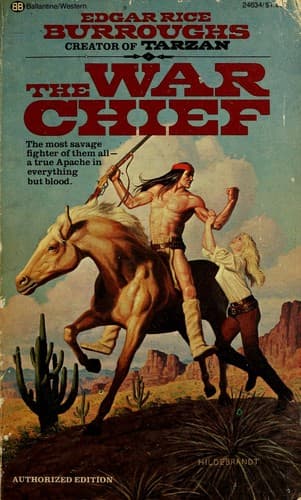
Apache Indians -- Fiction; Historical fiction; Western stories
“He said that he could not return your pony because it was dead, but
that he would send your friend back alive instead—he seemed to take it
for granted that I _am_ your friend.”
“Aint you?”
“I hope so, Chita.”
“’Twasn’t such a bad swap at that,” laughed the girl. “That ewe neck
roan was a sort o’ ornery critter anyways; but Dad did seem to set a
heap o’ store by it—anyways after it was gone. I never heered him do
anything but cuss it before.”
“He’ll probably always think it worth more than a soldier,” said King.
“I wouldn’t say that, and I wouldn’t give him no chance to think about
it at all. I reckon Dad wouldn’t be tickled more’n half to death if he
knew I’d give a hoss to an Injun.”
“You must have had a good reason to do it.”
“I sure did—I wanted to; but there was really a better reason than
that. This was the whitest Injun I ever see and I owed him something for
what he’d done for me. I couldn’t let a Injun be whiter than me, could
I? Listen—I’ll tell you all about it.”
When she had finished she waited, looking up at King for an expression
of his verdict upon her action.
“I think you did right, Chita,” he said, “but I also think that the less
said about it the better. Don’t you?”
“I aint been publishin’ the matter in no newspapers,” she returned. “You
pumped it out of me.”
They sat in silence for a long time then, and as King watched her face,
the easy, graceful motions of her lithe body, her slender fingers, her
dainty ankles, he was drawn to her as he had never been drawn to a woman
before. He knew her heart and soul must be as wonderful as her face and
form; he had caught a fleeting glimpse of them as she spoke of
Shoz-Dijiji and the loyalty that she owed him. What a wonderful creature
she would have made had she been born to such an environment of culture
and refinement as had surrounded him from childhood. He wanted to reach
out and touch her, to draw her toward him, to ask her if he might hope.
He was hopelessly, helplessly under the spell of her charms.
“I reckon, mister, I’ll be hittin’ the hay,” she said, rising.
“Chita!” he cried. “Why do you do it?”
“Do what—go to bed?”
“No, not that. Listen to me, Chita. I may offend you—I certainly don’t
want to, but I can’t sit here and look at you and then listen to you and
not speak.”
“You got me chokin’ leather,” she admitted, “and I’m two jumps behind at
that.”
“I suppose you know that you are a very beautiful girl,” he said.
“Beside your beauty you have character, intelligence, a wonderful heart.
But——” he hesitated. It was going to be hard to say and he was already
regretting that he had started it.
“Well,” she said, “but what? I aint committed no murders.”
“I haven’t any right to say what I started to say to you, Chita; except
that I—well, Chita, I think you’re the most wonderful girl I ever met
and I want you to be right in every way.”
Public-domain text, read in full here on John Shaqi.
Reviews
Reviews
No reviews yet
Be the first to share your thoughts on this work.
Elsewhere in the archive
Join the Discussion
Join the discussion
Sign in to leave a comment or review.
Sign InorCreate an account